









Spontaneous vs. Responsive Desire: What the Difference Actually Means for Your Sex Life
Content
- What Spontaneous and Responsive Desire Actually Are
- How Common Is Each Desire Style — and Does It Vary by Gender, Orientation, or Life Stage?
- Why Desire Changes in Long-Term Relationships
- Responsive Desire vs. Low Libido: How to Tell the Difference
- Physical and Hormonal Factors That Suppress or Mimic Desire
- Desire Mismatch Between Partners — and How to Talk About It
- Practical Warm-Up Strategies and Tools That Support Responsive Arousal
Responsive desire — feeling interested in sex after stimulation begins rather than before — is a well-documented, normal pattern, not a sign that something is missing; this article covers what both desire styles are, how common each is, why desire shifts in long-term relationships, how to tell responsive desire apart from low libido, and what practically helps arousal build.
- Responsive desire means interest arrives after engagement begins — not before.
- Both desire styles are normal; neither indicates dysfunction or low libido.
- Desire often shifts from spontaneous to responsive as relationships mature.
- Distress about your desire pattern — not the pattern itself — is the clinical threshold that matters.
- Warm-up strategies and the right tools can meaningfully support responsive arousal.
What Spontaneous and Responsive Desire Actually Are
Spontaneous desire arrives unprompted. You are doing something completely unrelated to sex, and a thought, a pull, an interest shows up on its own. Responsive desire works differently: the interest does not come first. It emerges after something has already started, a touch, a kiss, a mood, a context that makes your body and mind begin to engage.
Both are real desire. They just follow different sequences.
How Each Style Feels From the Inside
Spontaneous desire tends to feel like a sudden urge or a mental spark that arrives before any physical contact. You notice it as a thought, a fantasy, or a general wanting. It can show up at random moments, and it tends to feel self-generated. For people who experience desire this way most of the time, wanting sex and then seeking it out feels like the natural order.
Responsive desire feels different, and that difference is where a lot of confusion and unnecessary worry comes from. If you have a responsive desire style, you may not feel particularly interested in sex before it begins. You might even feel neutral or mildly indifferent when the idea comes up. But once engagement starts, once there is touch, warmth, closeness, or stimulation, interest begins to build. Desire arrives during, not before.
This gap between “not feeling it yet” and “actually feeling it once things get going” is sometimes called arousal lag. It is not a sign that something is wrong with you or that you are not attracted to your partner. It is simply how your system works: context comes first, desire follows.
Physically, responsive arousal can feel gradual. Blood flow increases, sensation sharpens, and what started as mild engagement shifts into genuine interest. Your body may show signs of arousal before your mind has fully caught up, or the reverse. Subjective desire and physical arousal are not always in sync, and that mismatch is normal. Noticing physical response without yet feeling mentally “into it” does not mean you are broken; it means your system is warming up.
A simple way to picture the difference: spontaneous desire is like a light switch. It flips on. Responsive desire is more like building a campfire. You need the right conditions, some initial effort, and a little time before it catches. Neither is better. They just need different approaches.
The Research Behind Both Patterns: Nagoski, Basson, and the Dual Control Model
The science here is clear and well-established. Responsive desire is not a deficit or a lesser version of spontaneous desire. It is a distinct, documented pattern with its own neurological and clinical basis.
Sex researcher Emily Nagoski has been one of the most influential voices in making this distinction accessible. Her work frames responsive desire as a completely normal variation, not a problem to fix. The older cultural assumption, reinforced by decades of movies, advertising, and even some early sex research, was that desire should appear spontaneously and that anything else indicated low libido or dysfunction. Nagoski’s work pushed back on that assumption directly, and the research supports her.
Physician and researcher Rosemary Basson proposed a circular model of sexual response that replaced the older linear model developed by Masters and Johnson. The linear model went: desire, then arousal, then orgasm, then resolution, in a straight sequence. Basson’s model recognized that for many people, especially in long-term relationships, the sequence does not start with spontaneous desire at all. Instead, a person might begin from a place of sexual neutrality, choose to engage for reasons like intimacy or connection, and then find that arousal and desire build from there. The motivation to engage precedes the felt desire, rather than the other way around. Empirically separating spontaneous and responsive desire matters not just for understanding sexuality but for how clinicians assess and support it.
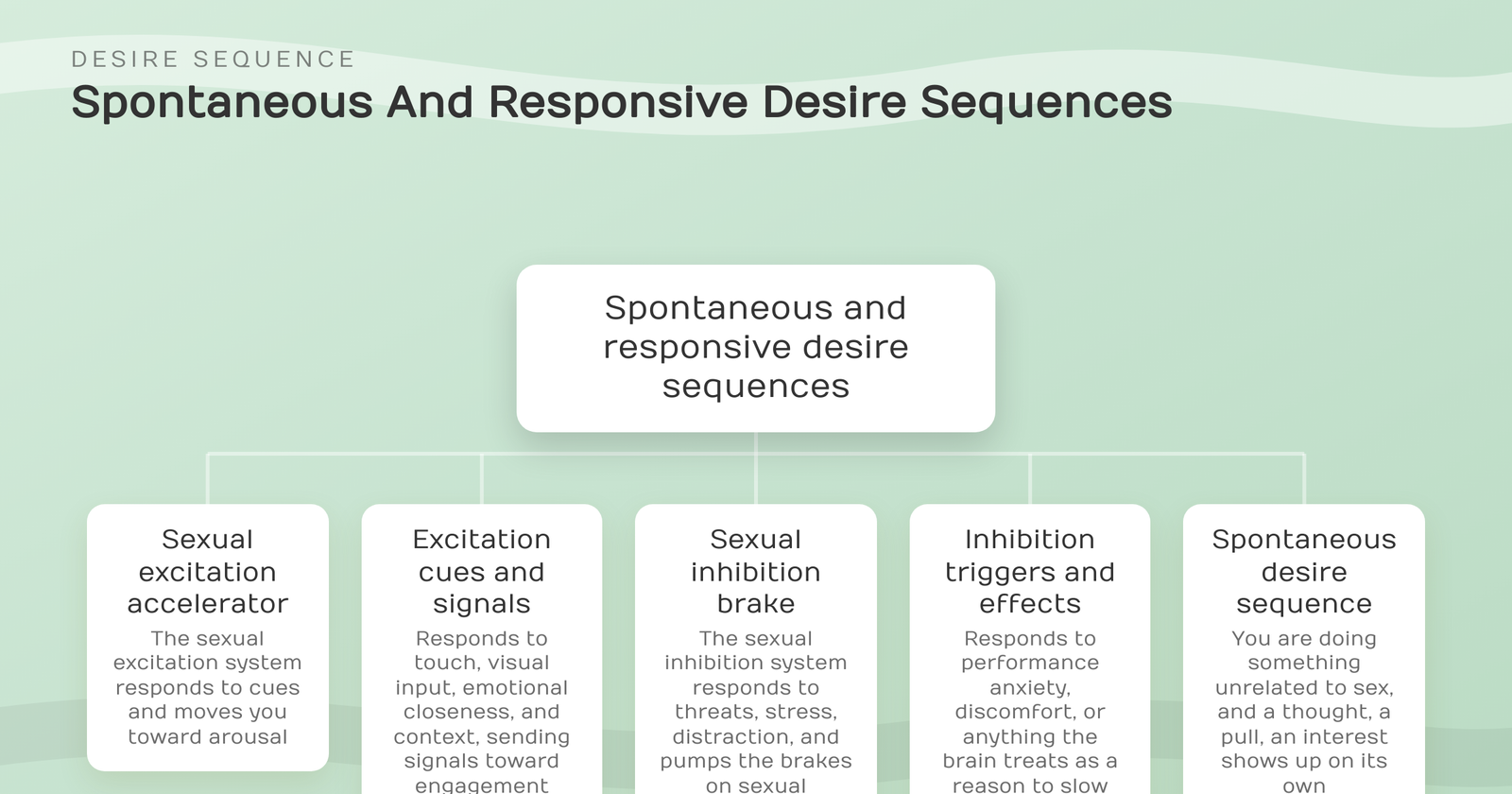
The dual control model, developed by researchers John Bancroft and Erick Janssen at the Kinsey Institute, offers the neurological framework underneath all of this. According to this model, sexual response is governed by two competing systems:
- The sexual excitation system (SES). This is the accelerator. It responds to sexually relevant cues, physical touch, visual input, emotional closeness, context, and sends signals that move you toward arousal and engagement.
- The sexual inhibition system (SIS). This is the brake. It responds to potential threats, stress, distraction, performance anxiety, discomfort, or anything the brain interprets as a reason to pump the brakes on sexual response.
Most people have both systems operating at once. How sensitive each system is varies between individuals. Someone with a highly sensitive accelerator and a quieter brake may experience desire that feels spontaneous and frequent. Someone with a less reactive accelerator or a more sensitive brake may need more context, more warmth, more deliberate input before desire builds. That is not dysfunction; it is individual variation in how the system is calibrated.
This is also why context matters so much for responsive desire. If the brake is engaged, because of stress, fatigue, distraction, or discomfort, arousal has a harder time building regardless of how much stimulation is present. Desire emerging after stimulation begins is a documented pathway, not a workaround for something broken.
Together, these models explain why responsive desire is not a sign of low interest, low attraction, or low libido. It is a different starting point. Both patterns are common, and desire can shift with context or life stage, though the full picture of how common each style is belongs in the next part of this article.
If you want to go deeper into the science, Nagoski’s research and the broader literature on women’s sexuality are well covered in the educational books in this space, which can be a useful next step for anyone who wants more than a summary.
How Common Is Each Desire Style — and Does It Vary by Gender, Orientation, or Life Stage?
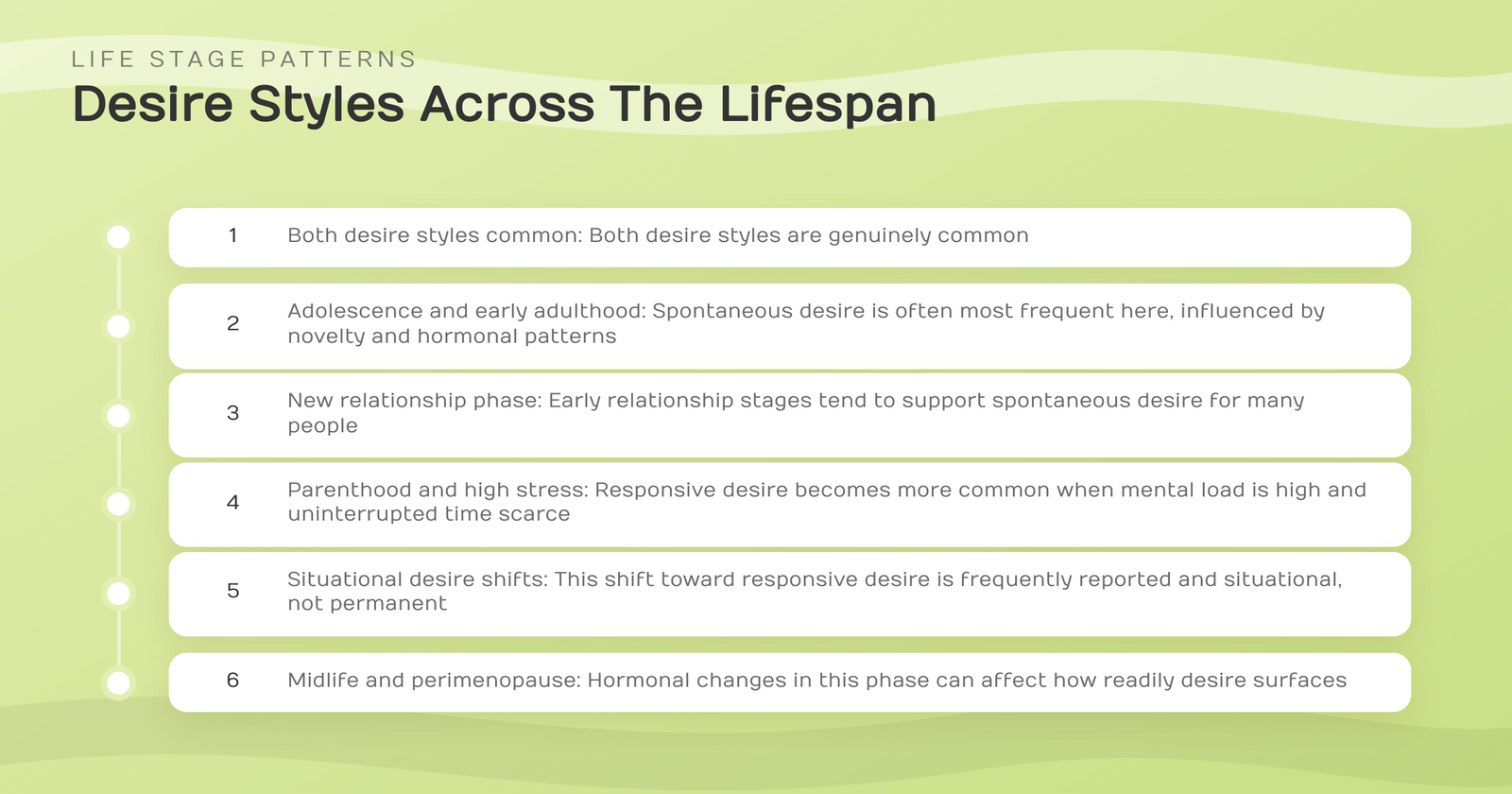
Both desire styles are genuinely common. Spontaneous desire is more frequently reported by men and by people earlier in a relationship or earlier in adult life. Responsive desire is more frequently reported by women, people in long-term relationships, and those in certain life stages. Neither pattern is rare, and neither is a sign that something is off.
Research suggests that somewhere between 15 and 30 percent of women report primarily spontaneous desire, while a larger share report desire that is mostly responsive or a mix of both. Among men, those numbers roughly flip, though a meaningful portion of men also experience primarily responsive desire. The key word in both cases is “primarily.” Most people do not fit cleanly into one category or the other, and epidemiologic data shows that responsive and spontaneous patterns can and do co-occur in the same person, which means the two styles are not always neatly separable in real life.
One of the more persistent myths worth clearing up: responsive desire is not a female pattern. It shows up across genders. Men who have been in a long relationship, are under sustained stress, or are moving through midlife commonly find that desire no longer arrives unprompted the way it once did. That shift is normal, not a dysfunction, and not a signal of lost attraction.
Sexual orientation does not determine desire style either. Responsive desire is well-documented across gay, lesbian, bisexual, and queer relationships. Because desire is shaped by context, stress, relationship dynamics, and individual sensitivity to sexual cues rather than by gender identity alone, people across the full spectrum of orientations and gender identities experience both styles. If you are exploring resources specific to your experience, LGBTQ+ sexual wellness tools are one practical starting point.
Desire style also tends to shift across the lifespan, sometimes more than once. A few common patterns:
- Adolescence and early adulthood. Spontaneous desire is often at its most frequent here, driven partly by novelty and hormonal patterns that are still establishing themselves.
- New relationships. The early phase of a relationship tends to support spontaneous desire for many people, regardless of their usual baseline.
- Parenthood and high-stress periods. Responsive desire becomes more common when mental load is high and uninterrupted time is scarce. This is one of the most frequently reported shifts, and it is situational, not permanent.
- Midlife and perimenopause. Hormonal changes during this phase can affect how readily desire surfaces. (The hormonal detail belongs to a separate part of this article; the point here is simply that the shift in desire style is common and well-documented.)
- Older adulthood. Responsive desire often becomes the dominant pattern with age, without any corresponding drop in sexual satisfaction when people understand and work with it.
The practical takeaway is that your desire style at 24 is not necessarily your desire style at 44, and your desire style in a new relationship may look nothing like your desire style five years in. Context shapes desire differently for different people, which is part of why the same person can experience spontaneous desire in one situation and responsive desire in another.
Neither style is more sexually healthy, more evolved, or more loving than the other. The only thing that matters is whether your pattern works for you and, if you have a partner, whether you understand each other’s patterns well enough to work with them.
Why Desire Changes in Long-Term Relationships
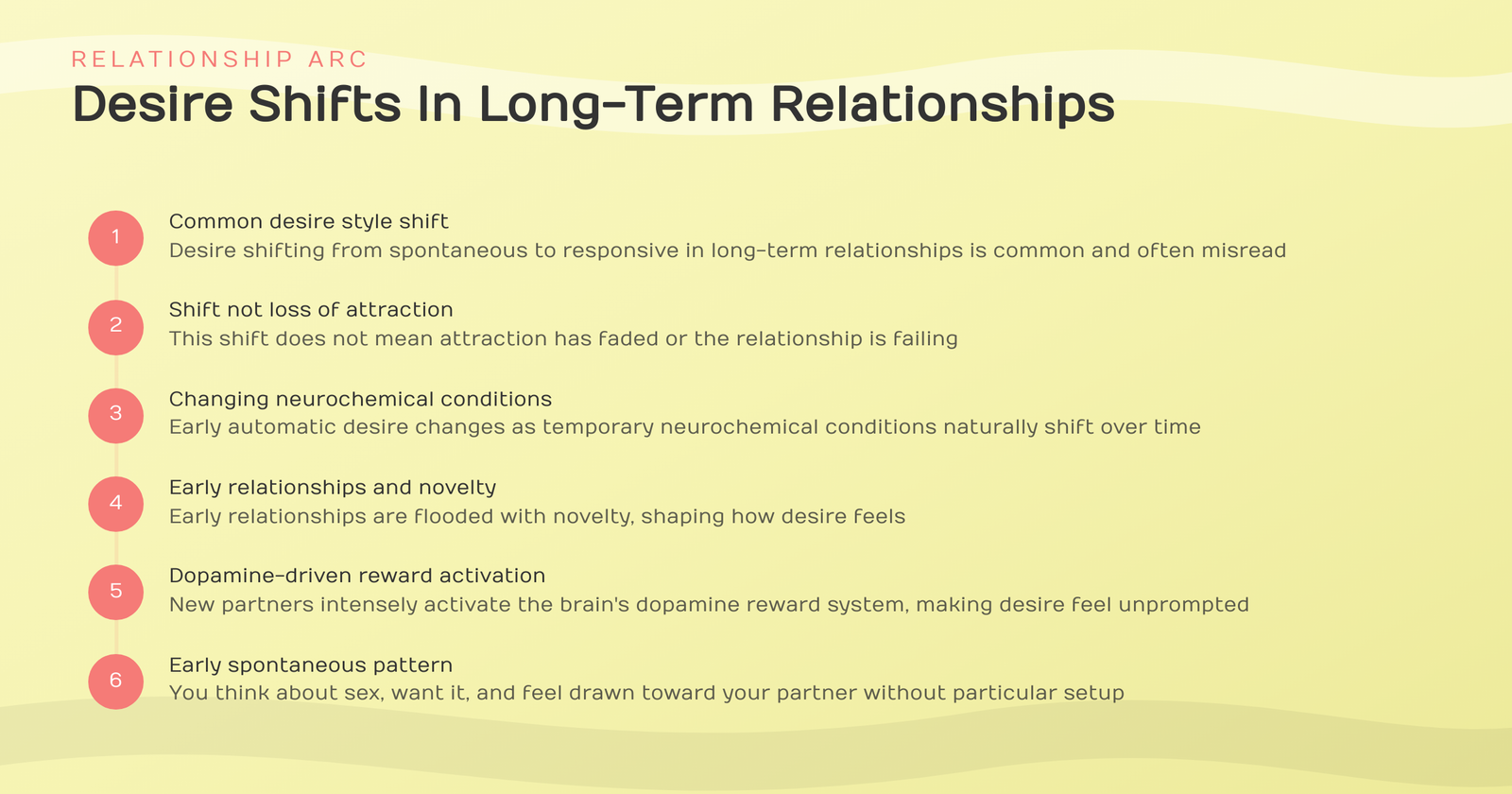
Desire shifting from spontaneous to responsive over the course of a long-term relationship is one of the most common experiences people have, and one of the most misread. It does not mean attraction has faded or the relationship is failing. It means the neurochemical conditions that made early desire feel automatic have changed, because they were always temporary.
Early relationships are flooded with novelty. New partners activate the brain’s dopamine-driven reward system intensely, and that activation makes desire feel like it arrives on its own, unprompted. You think about sex, want it, and feel drawn toward your partner without any particular setup. This is the honeymoon phase, and the brain is doing something genuinely unusual during it. That state is not a baseline. It is a peak.
As familiarity builds, dopamine response to the same stimuli naturally decreases. This is not a flaw in your relationship; it is how reward systems work. The brain stops firing as intensely at predictable stimuli. What once felt like an automatic pull becomes something that needs a little more context to get started. Comfort, routine, and emotional safety, which are real relationship strengths, also reduce the novelty that once triggered desire so reliably.
Emotional safety plays a more complex role than people expect. Feeling understood and valued by a partner is linked to greater sexual desire in established relationships, which means the quality of emotional connection genuinely shapes how desire shows up. A relationship where one partner feels unseen or dismissed creates conditions that suppress desire, while one where both people feel met tends to support it.
Life accumulates, too. Children, work pressure, financial strain, and caregiving all function as brakes on desire. They are not excuses; they are real physiological and psychological load. Stress narrows attention and reduces the mental space that desire needs to emerge. Hormonal shifts, including those around postpartum recovery or perimenopause, can compound this further.
The useful distinction here is between desire that has shifted style and desire that has genuinely diminished. If interest still arrives once you are engaged, once there is touch, closeness, or a moment of real connection, your desire is responsive, not absent. Research on long-term relationships consistently shows that desire is shaped by individual, interpersonal, and contextual factors over time, not fixed at one level or one style. A mismatch in how each partner experiences this shift can create real tension, but that is a communication and initiation question, not evidence that the relationship or the desire is broken.

Responsive Desire vs. Low Libido: How to Tell the Difference
The clearest distinction is this: responsive desire means interest arrives once engagement begins; genuinely low libido means interest rarely or never arrives, even after extended, comfortable stimulation. One is a timing difference. The other is an absence.
That distinction matters because responsive desire is frequently mistaken for low libido, by the person experiencing it and by their partner. If you expect desire to show up before anything starts, and it does not, it is easy to conclude something is wrong. But if interest reliably builds once you are physically close, touched, or otherwise engaged, your desire is working. It is just working on a different schedule.
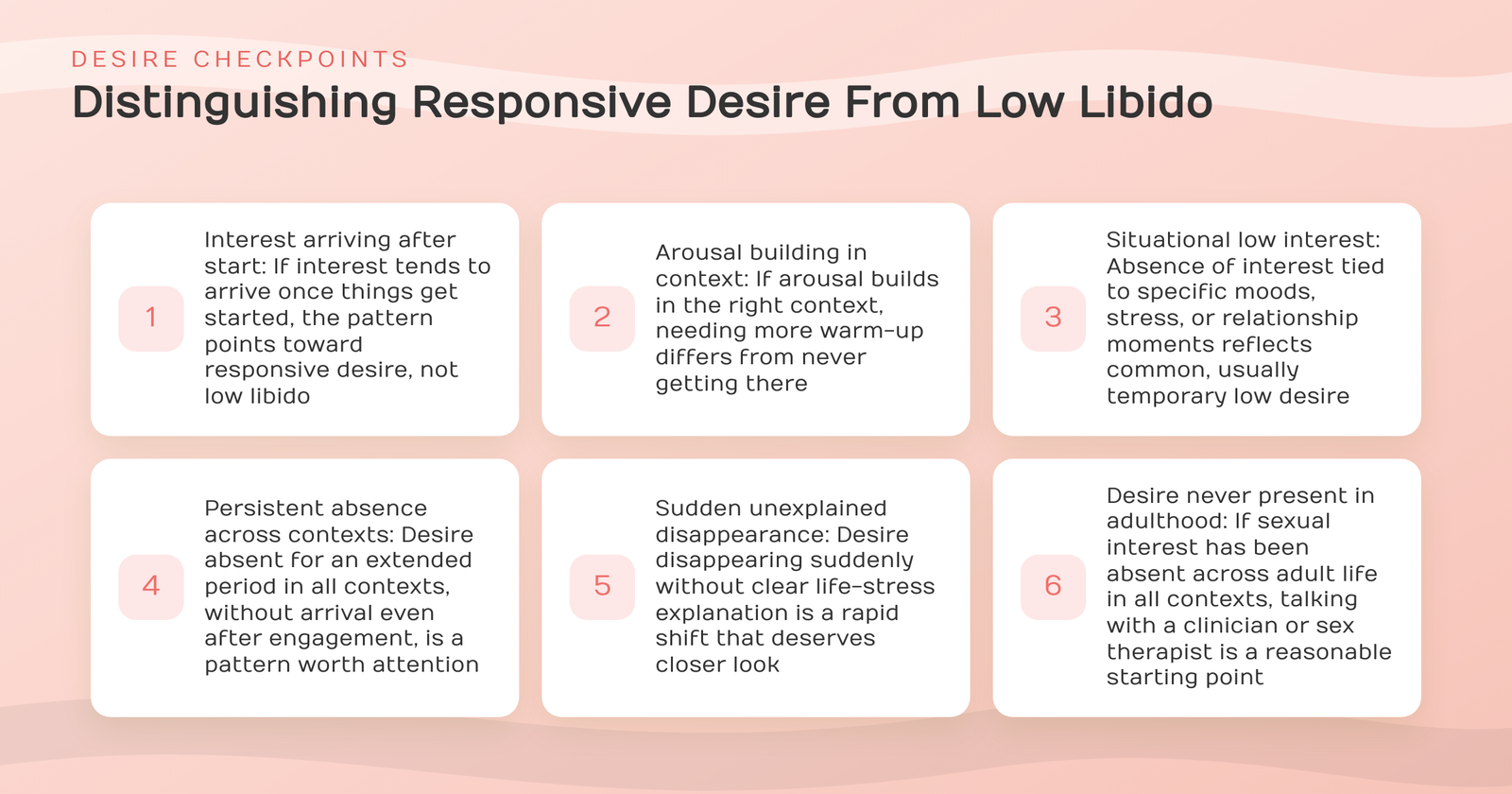
A useful set of questions to ask yourself:
- Does interest tend to arrive once things get started? If yes, that pattern points toward responsive desire, not low libido.
- When you are in the right context, does arousal actually build? Needing more warm-up is different from never getting there.
- Is the absence of interest specific to certain moods, stress levels, or relationship moments? Situational low desire is common and usually temporary.
- Has your desire been absent for an extended period, across all contexts, with no sign of arrival even after engagement? That pattern is worth paying attention to.
- Has desire disappeared suddenly, without a clear life-stress explanation? A rapid, unexplained shift deserves a closer look.
It also helps to separate two different experiences that can feel similar in the moment: not being in the mood beforehand, and genuinely not wanting sex at all. The first is the normal starting point for responsive desire. The second is useful information about a given moment, a temporary period, or possibly a longer pattern worth tracking.
Temporary low-desire periods are common and often tied to stress, fatigue, illness, or life transitions. Physical factors, including hormones and certain medications, can also suppress desire in ways that look like low libido but have a treatable cause. Relationship dynamics can have a similar effect. Neither of those is the same as a persistent, baseline absence of sexual interest.
The clinical line, according to research on sexual interest and arousal, is not the desire pattern itself. It is personal distress. A person whose desire is fully responsive but who feels satisfied with their sex life does not meet the threshold for a clinical concern. A person who is persistently troubled by their desire, whatever form it takes, does.
| Feature | Responsive Desire | Low Libido |
|---|---|---|
| When interest arrives | After stimulation or engagement begins | Rarely or not at all, even after engagement |
| Arousal with warm-up | Builds with the right context | Does not build despite adequate warm-up |
| Duration | Ongoing pattern, often stable | May be temporary or persistent |
| Clinical concern threshold | Not a concern without personal distress | Warrants attention if distressing or sudden |
When Low Desire Warrants Professional Support
Seeking support makes sense when the distress threshold is met: when low desire is persistent, causes you real unhappiness, and is not explained by an obvious temporary stressor.
Specific situations that are worth bringing to a professional:
- Desire has never been present. If sexual interest has been absent across your adult life, in all contexts, a conversation with a clinician or sex therapist is a reasonable starting point.
- Responsive desire has stopped working. If you previously noticed interest building with engagement and that no longer happens, something has changed and is worth identifying.
- The shift was sudden and unexplained. A rapid drop in desire, without a clear life-stress reason, can sometimes signal a physical or hormonal factor that a medical evaluation can identify.
- The distress is persistent. Feeling consistently upset, broken, or disconnected from your own desire, over weeks or months, is reason enough to talk to someone.
Two types of support are most relevant here. A sex therapist can help you understand your desire pattern, address any distress around it, and work through relational dynamics that may be contributing. A medical provider can rule out or treat physical causes. Both are appropriate next steps depending on what your self-assessment surfaces.
If you have confirmed that your pattern is responsive desire and you are looking for practical ways to support arousal, arousal gels and creams are one tool worth knowing about. They are designed to support physical arousal during warm-up, which is exactly when responsive desire needs the most help.


Physical and Hormonal Factors That Suppress or Mimic Desire
Sometimes what looks like a desire problem is actually a physical one. Several common, treatable conditions can suppress sexual interest or make arousal harder to reach, and knowing the difference matters for how you respond to it.
Stress is one of the most reliable desire suppressors most people underestimate. When cortisol stays elevated from chronic stress, the body’s sexual inhibition system gets a steady signal to stand down. This affects both spontaneous and responsive desire, meaning even the right conditions may not be enough to get things moving. Addressing the stress itself, not just trying harder to feel interested, is usually the more productive path.
Hormonal shifts can change desire significantly across different life stages. Testosterone and estrogen both support sexual interest and arousal; when they drop, desire often follows. This happens during the luteal phase of the menstrual cycle, during perimenopause and menopause (when estrogen decline can also cause vaginal dryness, making sex physically uncomfortable), and in the postpartum period, when a hormonal crash combines with physical recovery, possible breastfeeding, and exhaustion to suppress desire from multiple directions at once. These are recognized contributors to desire changes at distinct life stages, not signs of a broken relationship or a broken libido.
Hormonal contraception can blunt desire in some people. Combined oral contraceptives lower free testosterone in some users, which can reduce sexual interest. If you noticed a change in desire after starting a hormonal method, it is worth discussing alternatives with your provider.
Medications are a commonly missed factor. SSRIs and other antidepressants, antihypertensives, antihistamines, and some hormonal treatments can all suppress desire or delay arousal as a side effect. If you are on any of these and have noticed a shift, desire changes are multifactorial and medication adjustment is a reasonable conversation to have with your prescriber.
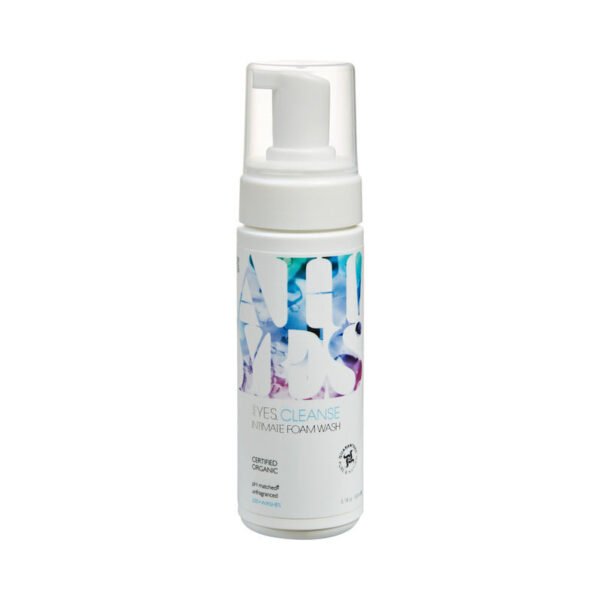
Vaginal dryness is a physical barrier that can be mistaken for absent desire. If sex is uncomfortable, the body learns to avoid it, which can look like low desire but is actually a pain-avoidance response. This is especially common during perimenopause, postpartum recovery, and with certain medications. A good lubricant addresses the physical barrier directly; water-based formulas are the most broadly compatible option and safe with all toy materials.
Pelvic floor tension and pain during sex (dyspareunia) work similarly. When sex hurts or creates anticipatory anxiety about pain, desire naturally retreats. This is a physical issue, not a psychological one, and pelvic floor physical therapy is often the most effective first step.
Sleep deprivation and fatigue are underrecognized suppressors. Poor sleep raises cortisol, lowers testosterone, and reduces the cognitive and physical resources that arousal requires. Chronic illness and ongoing pain conditions compound this further, making desire harder to access even when the relationship context is good.
A practical rule: if your desire shifted noticeably after a medication change, a hormonal transition, a new diagnosis, or a period of poor sleep, start there before assuming the issue is psychological. If the change is persistent and causing you distress, a conversation with a healthcare provider is the right next step.
Desire Mismatch Between Partners — and How to Talk About It
When one partner initiates constantly and the other rarely does, it is easy to read that gap as rejection or incompatibility. Most of the time, it is neither. It is a difference in desire style.
The partner with spontaneous desire feels interest arise on its own and naturally reaches out first. The partner with responsive desire needs some context, closeness, or stimulation before interest shows up. Neither pattern is wrong, but when neither partner understands the difference, the gap between them tends to widen.
What usually happens is this: the higher-desire partner initiates more, the lower-desire partner feels pressured and pulls back, and the higher-desire partner reads that withdrawal as disinterest and pushes harder. Therapists call this the pursuer-withdrawer cycle. Pressure accelerates avoidance; avoidance increases pressure. Both partners end up feeling misunderstood.
The lower-desire partner often carries the heavier emotional weight. When the message received is “you never want me,” it is easy to internalize that as something being wrong with you. If your desire style is responsive, you may genuinely enjoy sex once it begins, but you are measuring yourself against a spontaneous model that was never yours to begin with.
Reframing the conversation around desire style rather than frequency or rejection changes the dynamic. Open discussion about sex is associated with higher desire and sexual satisfaction, and sexual communication overall consistently predicts both relationship and sexual satisfaction. The conversation does not have to be heavy. It can start with something simple: “I think I have responsive desire, which means I usually need to warm up before I feel interested. It is not about you.”
Some language that actually works:
- For the spontaneous-desire partner initiating: “I would love to be close with you tonight. No pressure either way, just letting you know I am interested.” This opens a door without creating an obligation.
- For the responsive-desire partner communicating openness: “I am not feeling it right now, but I am open to starting and seeing where it goes.” This is honest and removes the binary of yes or no.
One structured tool worth trying is the yes-no-maybe list. Each partner independently marks a range of activities as yes (enthusiastic), no (not interested), or maybe (open to it with the right context). Comparing lists shifts the conversation from “why don’t you want me” to “here is where our interests overlap.” Adult intimacy card games can serve a similar function, giving couples a low-stakes format for mapping desire without it feeling like a negotiation.
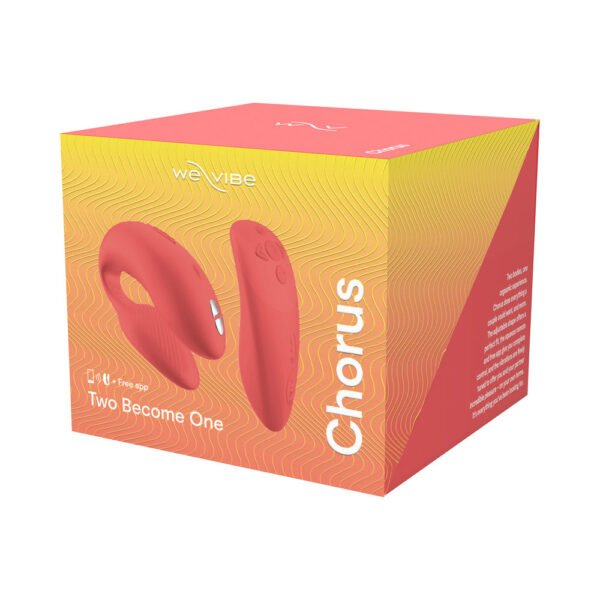
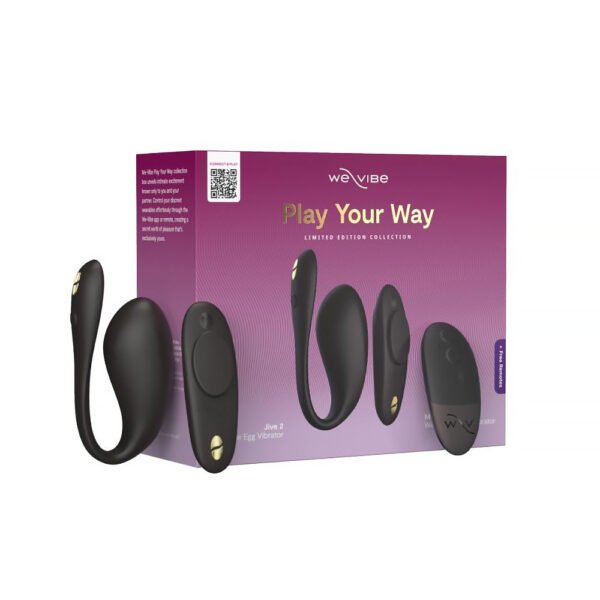
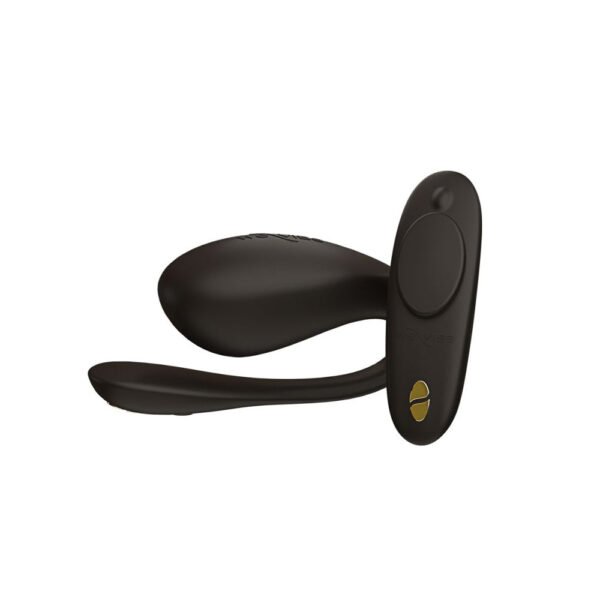
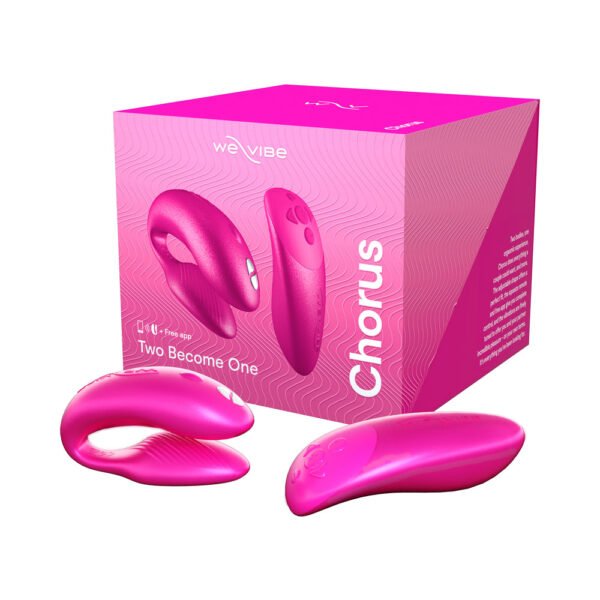
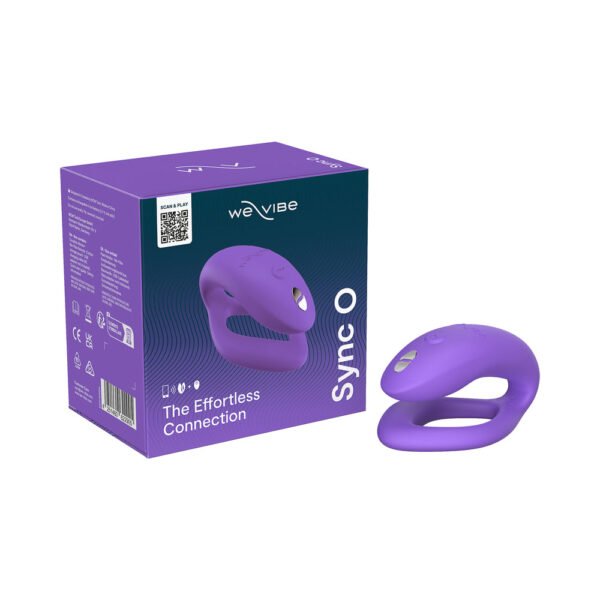
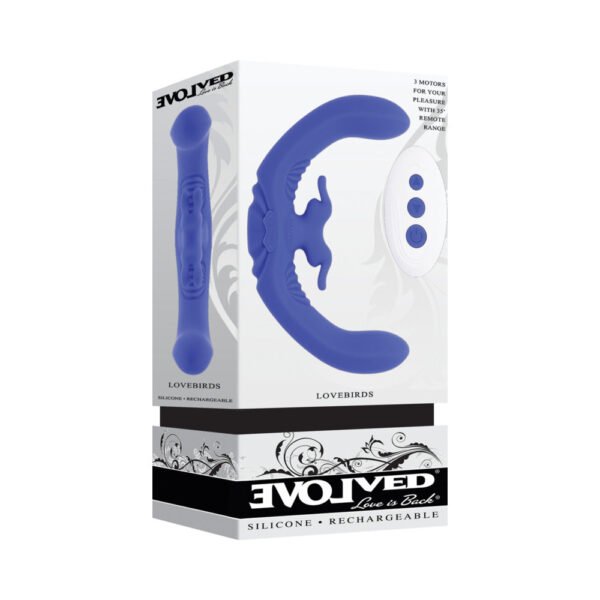
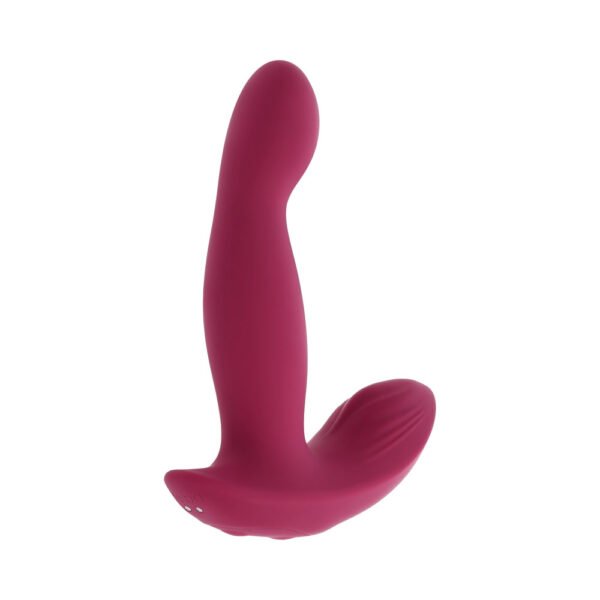
It is also worth naming that emotional safety is not just a nice-to-have. Feeling genuinely understood by a partner is itself a condition that supports responsive desire. When the lower-desire partner stops bracing for pressure, there is more room for interest to arrive on its own terms. Couples’ toys can help bridge the gap practically, giving both partners a shared experience that reduces performance pressure on either side.
Physical factors like fatigue or hormonal shifts can compound mismatch, and warm-up tools can help arousal build when it is slow to start, but the foundation is communication.
If the mismatch is causing real distress for one or both of you, a sex therapist or couples counselor who works with desire differences is a practical next step. Mismatch is one of the most common issues they see, and it is one of the most workable.

Practical Warm-Up Strategies and Tools That Support Responsive Arousal
Responsive desire needs a window, not a switch. The most useful shift you can make is treating warm-up as a legitimate part of sex rather than a delay before it starts. Building that window intentionally, and removing the friction that collapses it, is where most of the practical work happens.
Initiation Approaches That Reduce Pressure
The most effective initiation for a responsive-desire partner is one that opens a door without requiring an answer at the threshold. A low-pressure invitation sounds less like “do you want to have sex?” And more like “want to lie down together for a bit?” It creates conditions for desire to emerge rather than asking for desire to already be present.
Non-sexual touch is the most reliable starting point. Massage, slow physical closeness, holding without expectation: these lower the nervous system’s baseline enough for arousal to become possible. Massage oils are useful here, not as a seduction prop, but as a sensory cue that signals a shift in the environment without creating any obligation. The touch itself is the point.
Sensory environment matters more than most people expect. Lowering the lights, reducing noise, putting the phone away, and making the physical space feel different from the rest of the day all reduce friction. Responsive arousal is context-sensitive; removing distractions is not mood theater, it is genuinely functional.
Scheduling sex works well for responsive-desire couples when it is framed correctly. The goal is not to perform desire at a set time; it is to protect time so that warm-up can actually happen. Knowing that Tuesday evening is set aside means you are not starting from zero at 10 p.m. After a full day. The schedule creates the conditions; the desire follows from there.
One distinction worth making clearly: there is a real difference between needing more warm-up and genuinely not wanting sex right now. Needing warm-up means you are open but not yet engaged. Not wanting sex means no, even with context and time. Both are valid, and knowing the difference matters for consent. A useful internal check is whether the idea of sex feels neutral-to-possible or actually unwelcome. Responsive desire often starts at neutral; that is normal. Starting at unwelcome is a different signal, and it deserves the same respect.
Common mistakes that short-circuit the warm-up window:
- Rushing the timeline. Expecting arousal to appear within the first few minutes and reading its absence as rejection or disinterest.
- Skipping the conversation. Letting a partner guess at warm-up needs rather than saying simply what helps. A brief mention of what works for you reduces pressure for everyone involved.
- Treating desire like a switch. Assuming that interest should either be present or absent, with no in-between state worth working with.
Products That Help Arousal Build Gradually
The right tools for responsive arousal share one quality: they work with a slow build rather than assuming readiness. None of them require prior interest to use effectively.
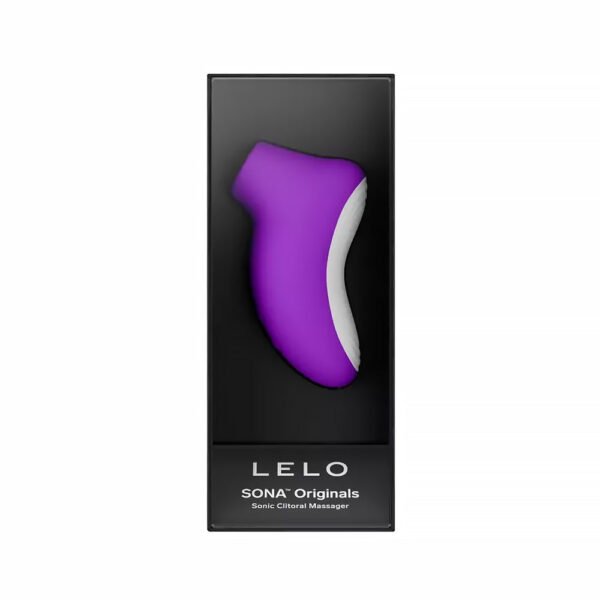
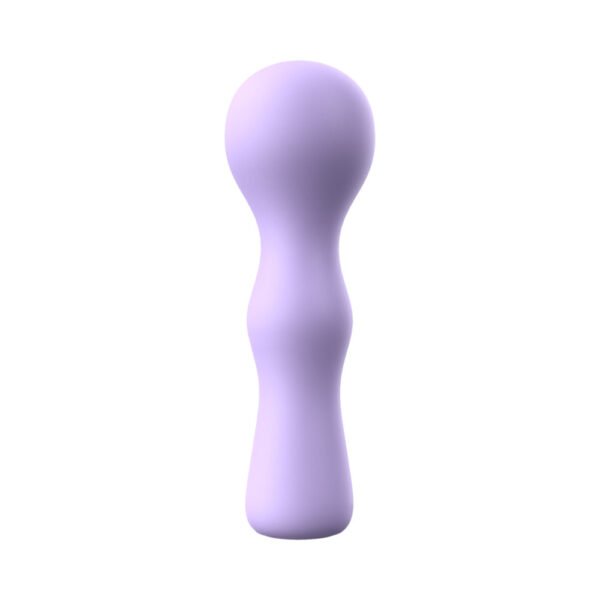
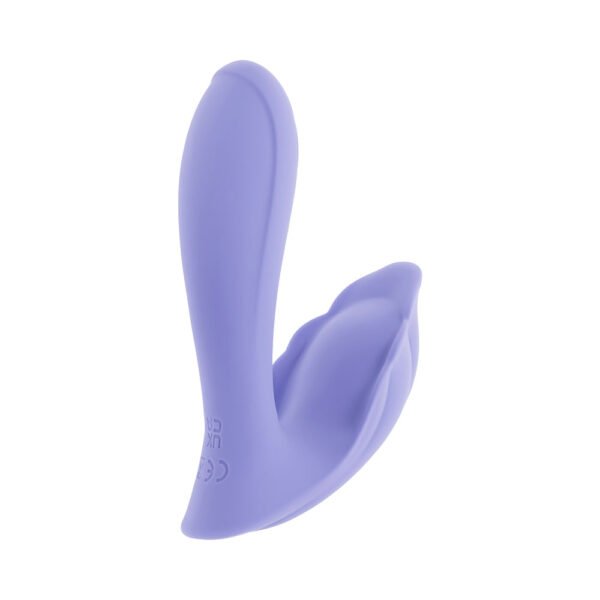
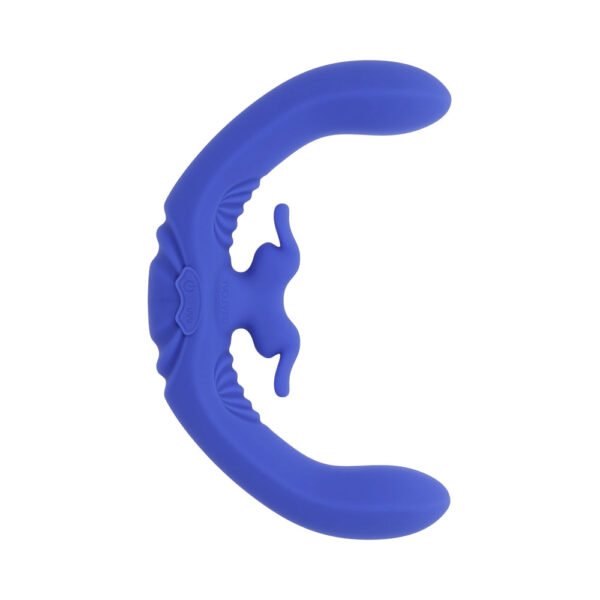
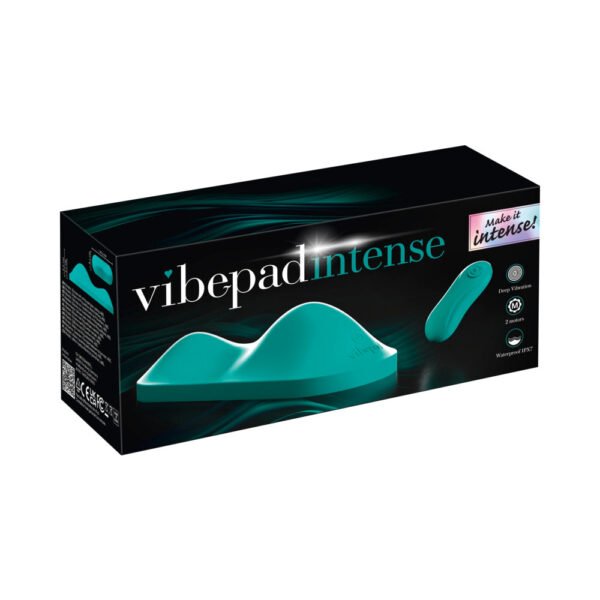
External clitoral stimulators are the most directly relevant category here. They provide focused stimulation without requiring penetration or a particular level of arousal to start. Because they work externally, they fit naturally into early warm-up rather than later stages. Look for models with lower-intensity settings and rumbly, deeper vibration patterns, which tend to build arousal more gradually than high-frequency buzzy motors.
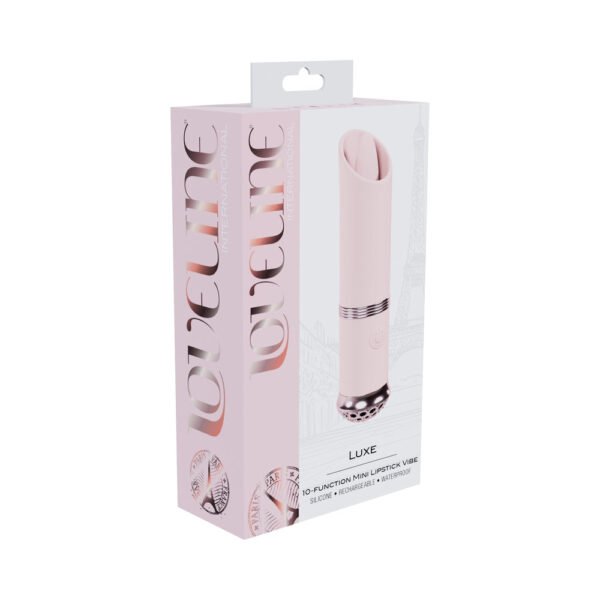
Bullet vibrators are a good beginner-friendly option in this category. They are small, low-intensity, and easy to use during foreplay without any particular setup or pressure. Many people find them useful precisely because they feel like a low-stakes addition rather than a production.
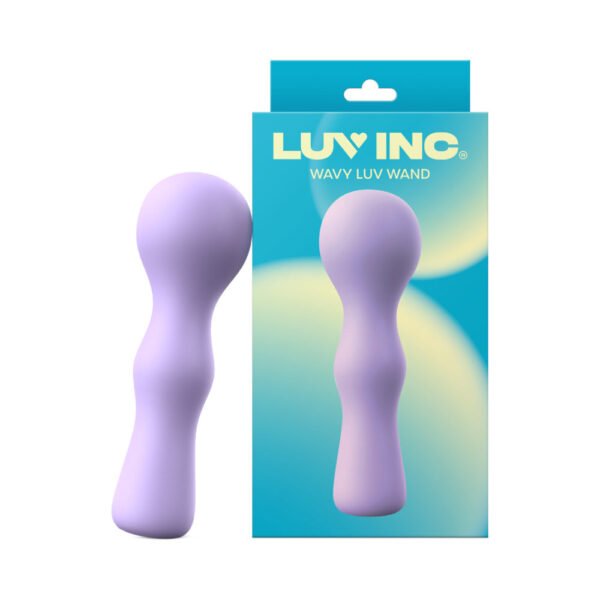
Wand vibrators take a different approach. Because they were originally designed as body massagers, they fit naturally into the non-sexual-touch phase of warm-up. Using a wand vibrator on the shoulders, back, or thighs before moving toward genital stimulation supports full-body relaxation and lets arousal build without a sharp transition. The size and broad contact surface make them feel less targeted, which suits people who find direct stimulation too intense before they are warmed up.
Heated vibrators add a warming element that supports blood flow and physical relaxation during slow arousal build. Gentle warmth can help the body shift into a more receptive state, particularly when stress or tension is part of what is suppressing arousal. Warming lubricants work on a similar principle and have the added benefit of supporting comfort when natural lubrication lags behind subjective arousal, which is common and does not indicate a lack of interest.
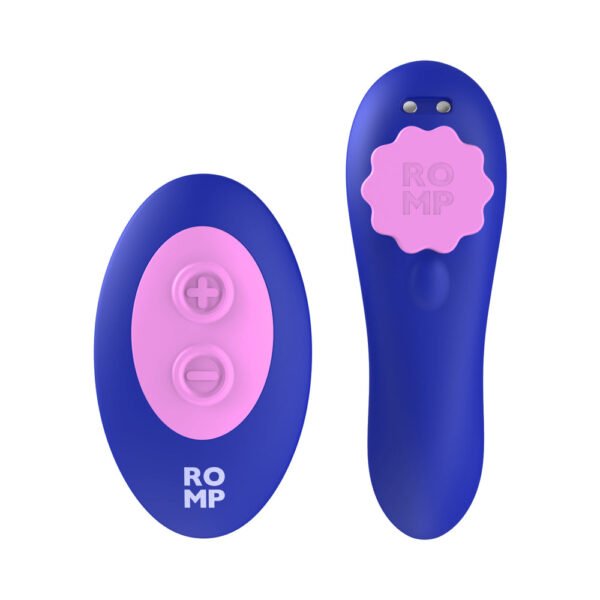
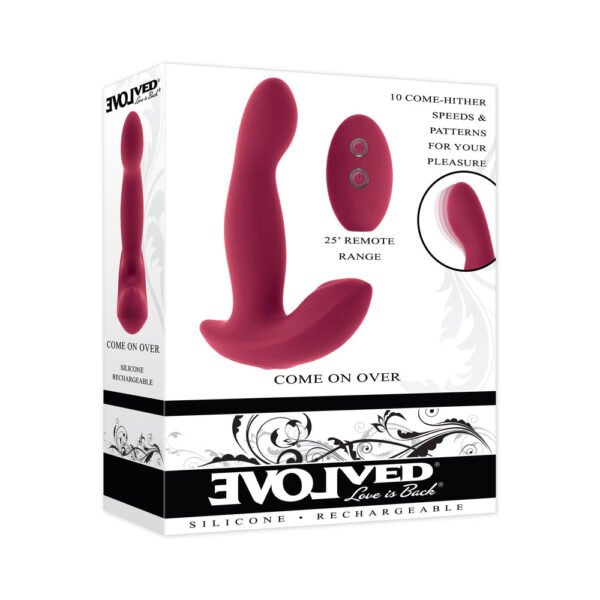
Water-based lubricant is compatible with all toy materials and is a straightforward addition any time comfort is an issue. (Hormonal factors that affect lubrication are covered separately in this article.) App-controlled and remote-control vibrators offer a low-pressure way for a partner to initiate engagement: the invitation is physical and gentle, and it leaves the responsive partner in control of what happens next.
The through-line across all of these tools is the same as the through-line for initiation: give arousal somewhere to go, reduce friction, and let the response come on its own schedule.


FAQ
Can a person shift between spontaneous and responsive desire depending on the situation?
Can a person shift between spontaneous and responsive desire depending on the situation?
Yes, and this is more common than most people realize. Stress, relationship phase, fatigue, hormonal shifts, and emotional closeness can all move you between patterns, sometimes within the same week. Someone who experiences spontaneous desire early in a relationship may find it becomes more responsive over time, and someone under significant stress may notice desire going quieter in both directions. Neither shift means something is wrong; it means desire is responding to context, which is exactly what it is designed to do.
Is it okay to have sex when you are not in the mood beforehand if you know desire usually shows up once things get started?
Is it okay to have sex when you are not in the mood beforehand if you know desire usually shows up once things get started?
Yes, as long as the decision is genuinely yours. Choosing to engage when you are neutral or mildly interested, knowing from experience that arousal tends to follow, is a reasonable and self-aware choice. The key distinction is between choosing to begin and feeling pressured to perform. If you notice that desire reliably arrives once you are engaged and you feel good about that pattern, it is working for you, not against you.
Does scheduling sex kill spontaneity, or can it actually work?
Does scheduling sex kill spontaneity, or can it actually work?
Scheduling works well for many people, especially those with responsive desire, because having a planned window removes the pressure of waiting for a spontaneous urge that may not arrive on its own. The trick is treating the scheduled time as an invitation rather than an obligation: you show up open to connection, not required to perform. Anticipation built around a planned evening can itself become a form of warm-up, which is the opposite of killing desire.