




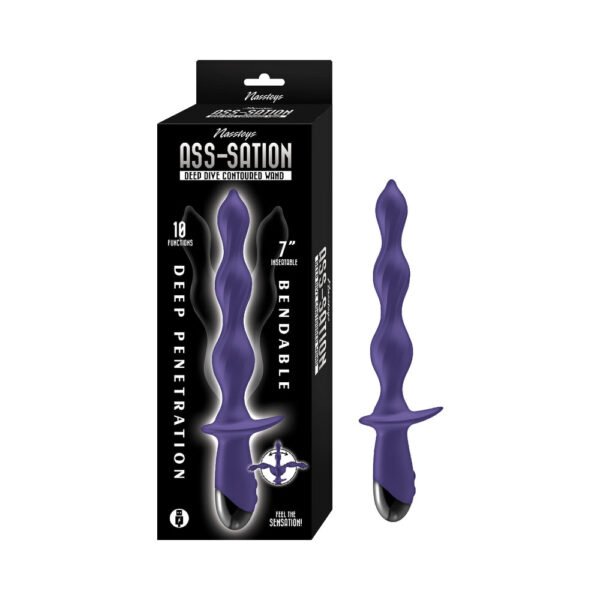




The prostate is a walnut-sized gland located in people with penises, sitting roughly 2 to 3 inches inside the rectum against the anterior (front) wall. It is sometimes called the P-spot, a shorthand borrowed from the logic of the G-spot, because, for many people, pressing or massaging it produces intense, diffuse pleasure that feels different from any other kind of stimulation. The gland itself is part of the reproductive system and surrounds the urethra, but its sensitivity comes from dense nerve-rich tissue and its proximity to the internal bulb of the penis. Stimulation can happen externally, by pressing the perineum (the skin between the scrotum and anus), or internally, via the rectum. Internal access gives more direct contact, which is why purpose-built prostate massagers have their characteristic angled, curved head.
How is the prostate typically stimulated with a toy?
A prostate massager is curved or angled forward at the tip specifically to reach the anterior rectal wall where the gland sits. Inserted a few inches in, the angled tip points toward the navel and makes contact through the rectal tissue. Most people find a firm but moderate pressure, held or rocked slowly, more effective than vigorous thrusting. Vibration adds a different layer to that contact: many massagers offer steady or pulsing modes that transmit sensation through the tissue to the gland directly.
A few practical variables determine how this actually feels:
- Angle and shape. The sharper the curve, the more direct the anterior-wall contact. Beginners tend to prefer a gentler curve and smaller head; experienced users may want a more pronounced angle for stronger pressure.
- Vibration type. Steady vibration produces constant stimulation; pulsing and escalating patterns change the sensation rhythmically. Both are valid and response to each is highly individual.
- External arm. Some massagers include a perineum arm that presses the external prostate point simultaneously. This dual-access design can intensify sensation but also adds size, so it is not always the right first choice.
- Lubrication. The rectum does not produce its own lubrication, so generous anal lube is not optional, it is necessary every time. Water-based formulas are compatible with all toy materials; silicone-based formulas should not be used with silicone toys because they can degrade the surface.
What to look for in a prostate toy
Material. The rectum has a highly absorbent mucosal lining, so material matters more here than almost anywhere else. Non-porous, body-safe materials, medical-grade silicone, borosilicate glass, stainless steel, have sealed surfaces that do not absorb bacteria or leach chemical additives. Porous materials (jelly rubber, PVC, unlabeled blends) trap bacteria in microscopic surface gaps that cannot be cleaned out, making them a real hygiene concern for anal use specifically.
Flared or wide base. Any toy used anally must have a flared base, a retrieval loop, or a wide enough base to sit outside the body. The rectum can draw objects inward through natural muscle contractions, and a toy without a safety base can require medical removal. This is a non-negotiable design requirement, not a stylistic preference.
Size for beginners. Starting smaller is consistently the smarter approach. Discomfort at insertion is a useful signal, not something to override. The prostate is reachable with modest insertable lengths, so a large toy offers no anatomical advantage and may make the experience harder than it needs to be.