







What Are Sex Toys Made Of? A Practical Guide to Sex Toy Materials

Content
- The Most Common Sex Toy Materials, Explained
- Why Porosity Is the Most Important Safety Factor
- How to Decode Labels, Marketing Names, and Safety Claims
- Which Material Works Best for Each Toy Type and Use Case
- Lubricant Compatibility by Material
- How to Clean, Store, and Know When to Replace Your Toys
- How to Evaluate a Toy You Already Own
Sex toys are made from a wide range of materials — and the material determines everything from how easy a toy is to clean to whether it’s safe for internal use. This guide covers the most common materials, porosity, label claims, lubricant compatibility, and cleaning.
- Nonporous materials like silicone, glass, and stainless steel are easier to clean and disinfect.
- Porous materials like TPE, jelly rubber, and PVC can trap bacteria even after washing.
- Terms like “silicone blend” and “medical-grade” are largely unregulated — label reading matters.
- Water-based lubricant is compatible with every toy material; silicone-based is not.
- Smell, tackiness, and discoloration are key warning signs on a toy you already own.
The Most Common Sex Toy Materials, Explained
Sex toys are made from a surprisingly wide range of materials, and the material is the single most consequential thing about any toy you buy. It shapes how a toy feels, how long it lasts, how easy it is to clean, and whether it belongs inside your body at all. Understanding the basic taxonomy before you shop makes every other decision easier.
At the broadest level, materials divide into two tiers: those that are nonporous and body-safe, and those that are porous or carry meaningful caution. Vibrators and similar devices are manufactured from many materials, including silicone, hard plastic, glass, stainless steel, rubber, vinyl, jelly rubber, and thermoplastic elastomers. Porosity is the dividing line that matters most, and the next section covers that in depth. What follows here is a plain-language profile of each material so you know what you are actually buying.
Body-Safe Nonporous Materials
These materials do not have microscopic pores that trap fluid or bacteria. They can be cleaned thoroughly, they do not off-gas or leach chemicals under normal conditions, and they are the materials most consistently recommended for internal use. Each one has a distinct physical character worth knowing.
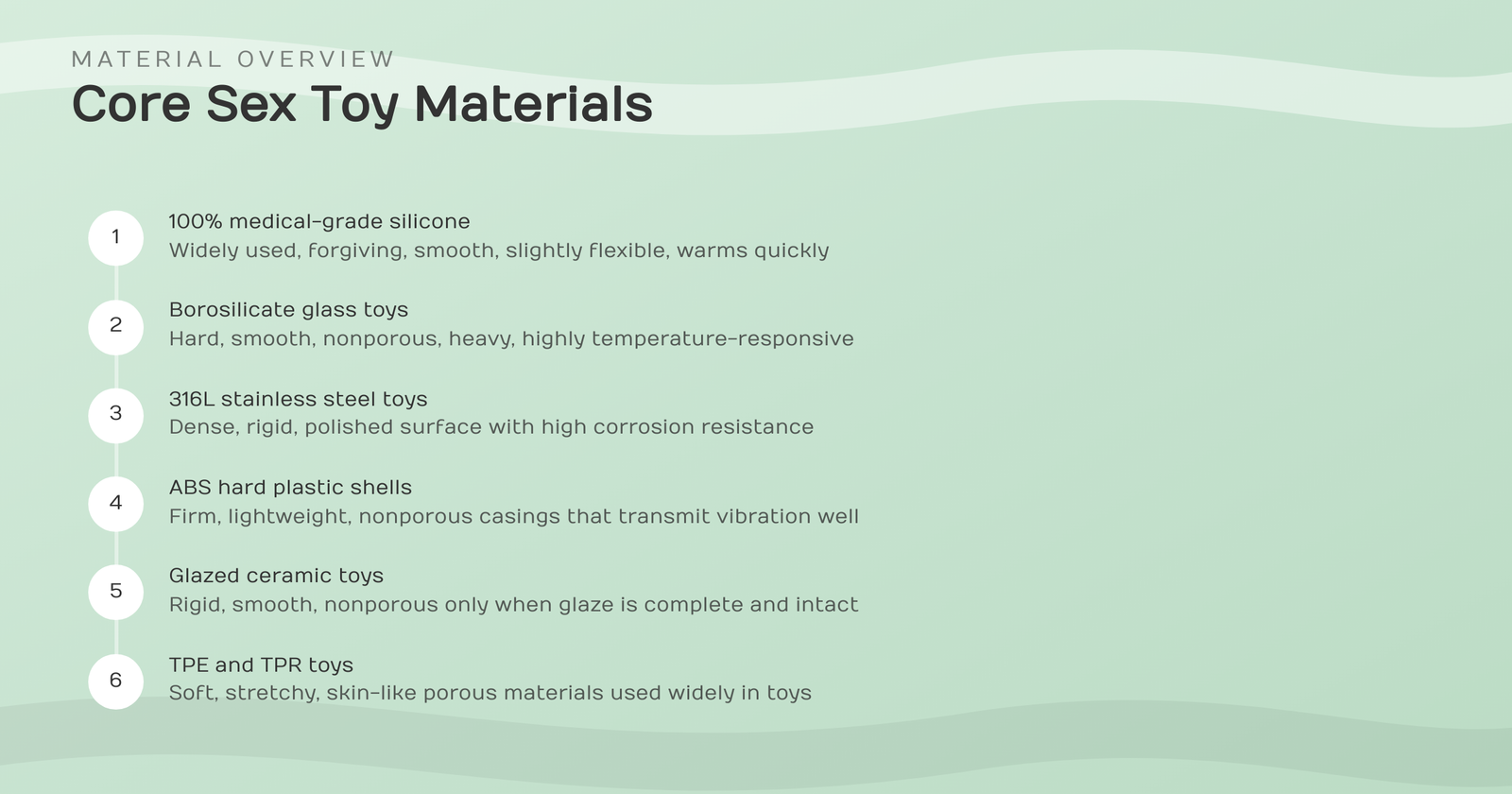
- 100% medical-grade silicone. The most widely used body-safe material in the industry. Platinum-cure silicone is soft to firm depending on formulation, slightly flexible, and has a smooth, matte surface that warms quickly to body temperature. It ranges from almost gel-soft to quite firm depending on the manufacturer’s blend. Silicone dildos are a good starting point for most people because the material is forgiving, lightweight, and available in a huge range of shapes and sizes. The key qualifier is “100%”: silicone blends and silicone-mix products are a different category entirely, addressed below.
- Borosilicate glass. Hard, smooth, completely nonporous, and temperature-responsive in a way no other material matches. Borosilicate glass heats or cools evenly and holds temperature well, which makes it a favorite for sensation play. It is heavier than silicone and has no give, which some people find more stimulating and others find less comfortable. Despite its reputation, borosilicate is break-resistant under normal use; it is not ordinary glass. Glass dildos are among the easiest toys to clean and among the most durable when handled with basic care.
- 316L stainless steel. Dense, weighty, and completely rigid. Stainless steel has a polished surface that feels cool at first contact and warms steadily with body heat. The weight itself is part of the experience for many people. 316L is the grade most commonly used in body-safe toys; it has higher corrosion resistance than 304 stainless, which matters for long-term durability and hygiene. Metal toys are among the most long-lasting options available.
- ABS hard plastic. A firm, lightweight plastic used widely in vibrator shells, bullet vibrators, and the hard casings of rechargeable toys. ABS is nonporous and body-safe when sourced from reputable manufacturers, though quality does vary. It has no flexibility and no temperature responsiveness to speak of. Its main strengths are durability, smooth surface, and its ability to transmit vibration efficiently. It is not typically used for insertables on its own but appears frequently as the structural layer beneath a silicone coating.
- Glazed ceramic. Less common but genuinely body-safe when the glaze is complete, chip-free, and properly fired. Glazed ceramic is rigid, smooth, and temperature-responsive similarly to glass. The glaze is what makes it nonporous; unglazed or cracked ceramic is not safe for use. Ceramic toys tend to be handcrafted and are more of a niche category, but they are a legitimate body-safe option when the manufacturer is transparent about materials and finishing.
The body-safe label only holds when the material is what it claims to be. 100% medical-grade silicone, borosilicate glass, 316L stainless steel, ABS plastic, and fully glazed ceramic are all genuinely nonporous, but the words “medical-grade” and “body-safe” on a label are largely unregulated, which means the material description itself deserves scrutiny before you trust it.
Porous and Caution Materials
Porous materials have a microscopic structure that can absorb fluid, bacteria, and other matter even after washing. This is the category where hygiene implications are real, though the full mechanism is covered separately. What matters here is knowing which materials fall into this tier and what they feel like, since many of them are still widely sold.
Analysis of sex toy composition shows that many toys use general consumer plastics rather than medical-grade polymers, including polyvinyl chloride, polyisoprene rubber mixtures, and silicone blends based on polydimethylsiloxane rather than pure platinum-cure silicone. That range of materials is reflected in what you will find on shelves today.
- TPE and TPR (thermoplastic elastomer / thermoplastic rubber). The most common porous materials in the current market. TPE and TPR are soft, stretchy, and skin-like in texture, which makes them feel realistic and comfortable. They are also flexible enough to accommodate a range of body shapes. The tradeoff is porosity: the surface structure absorbs fluids at a microscopic level that standard washing does not fully address. These materials are used in a wide range of toys from budget vibrators to realistic-feel strokers.
- Jelly rubber and jelly PVC. An older category that remains in production. Jelly rubber is very soft, translucent, and flexible, with a slightly tacky surface feel. It was once the dominant material for soft insertables and is still sold widely. Jelly rubber is porous and has historically been associated with phthalate content, though phthalate-free versions exist. A strong chemical odor on arrival is a common characteristic and a notable warning sign.
- PVC and vinyl. Firmer than jelly rubber but still porous. Standard PVC is used in a range of toys including some realistic-feel dildos, cock rings, and novelty items. Vinyl is similar in composition. Some manufacturers label PVC as “medical-grade” or “food-grade,” but those claims are not independently regulated in the sex toy industry and warrant skepticism without third-party verification.
- Latex and rubber blends. Stretchy, porous, and a concern for anyone with a latex allergy. Latex blends appear in some cock rings, realistic toys, and older-style insertables. The allergy consideration makes this material one to identify and avoid if you have any latex sensitivity.
- Silicone blends and silicone mixes. This is where labeling gets genuinely confusing. A product described as a “silicone blend” or “silicone mix” is not 100% silicone. These materials combine silicone with other polymers, typically to reduce cost or achieve a particular texture, and the resulting material is porous. The feel can be similar to pure silicone, which makes them easy to mistake for the real thing without knowing what to look for.
- CyberSkin, Superskin, UR3, and similar real-feel elastomers. Proprietary brand names for soft, realistic-feel materials designed to mimic skin texture closely. These are typically porous thermoplastic blends. They feel notably realistic and are popular in strokers and realistic dildos for that reason. They also tend to be more delicate than other materials, prone to tearing, and more demanding in terms of care. Most require cornstarch dusting to maintain their surface after washing.
The table below gives a quick comparison across the key physical properties that affect how a material feels and functions in practice.
| Material | Firmness | Flexibility | Temperature Responsive | Porosity Tier |
|---|---|---|---|---|
| 100% silicone | Soft to firm | Moderate to high | Mild | Nonporous |
| Borosilicate glass | Rigid | None | High | Nonporous |
| 316L stainless steel | Rigid | None | High | Nonporous |
| ABS hard plastic | Firm | None | Low | Nonporous |
| Glazed ceramic | Rigid | None | High | Nonporous |
| TPE / TPR | Soft to medium | High | Low | Porous |
| Jelly rubber / PVC | Very soft to medium | High | Low | Porous |
| CyberSkin / real-feel blends | Very soft | Very high | Low to moderate | Porous |
Knowing where a material sits in this taxonomy is the foundation for everything else: how you clean it, what lubricant you use with it, and whether it is appropriate for the kind of use you have in mind. If you are just starting to explore and want a practical shortcut, beginner-friendly options are most often made from 100% silicone or ABS plastic for exactly that reason: both are nonporous, widely available, and straightforward to care for.
Why Porosity Is the Most Important Safety Factor
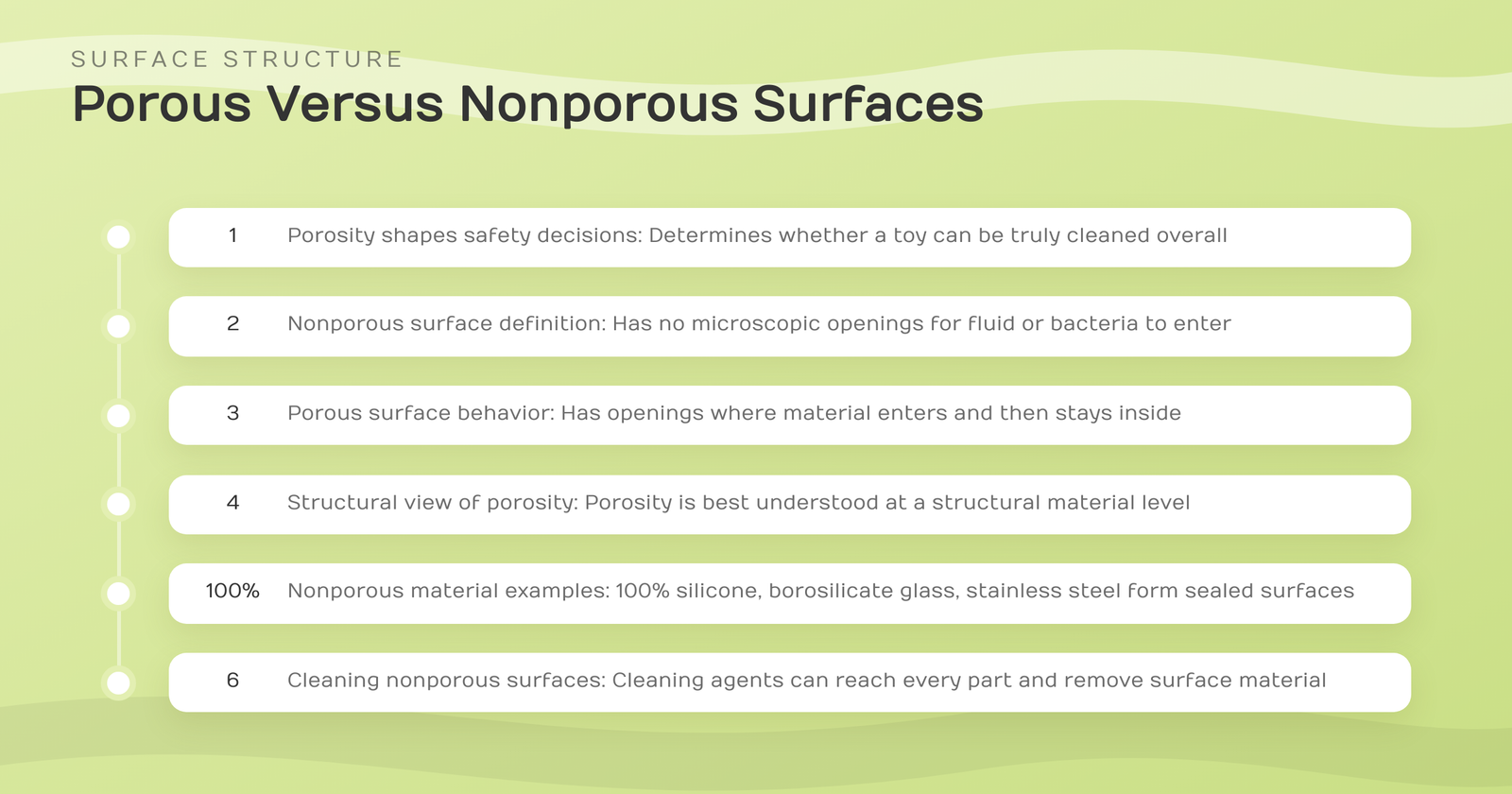
Porosity determines whether a toy can be truly cleaned, and that single factor shapes nearly every safety decision you make about a toy. A nonporous surface has no microscopic openings for fluid or bacteria to enter. A porous surface does, and once something gets in, it stays.
Think of it at a structural level. Nonporous materials like 100% silicone, borosilicate glass, and stainless steel have a continuous, sealed surface. Cleaning agents can reach every part of that surface and remove what’s there. Porous materials, including TPE, jelly rubber, and PVC, are riddled with tiny channels and gaps throughout their structure. Those gaps are invisible to the eye but large enough to trap bacteria, bodily fluids, and lubricant residue deep inside the material itself, not just on the surface.
Washing a porous toy removes what’s on the surface. It does not reach what’s inside. Over time, bacteria in those channels can form biofilm, a protective matrix that makes them even harder to eliminate. The toy may look clean and smell fine at first, then develop persistent odor or visible staining that no amount of soap and water resolves. That odor is biological material that has become part of the toy.
Sexual devices made of nonporous materials are the safest and easiest to clean and disinfect, while porous materials should be avoided for internal use because they cannot be fully disinfected and are prone to material breakdown over time.
The infection risk is not theoretical. Clinical guidance on sexual devices consistently identifies nonporous materials as the standard for body-safe toys, precisely because disinfection is only reliable when the surface has nowhere to hide contamination.
The risk increases for internal use because of how mucosal tissue works. The vaginal canal and rectum are lined with non-keratinized mucosa, tissue that is more permeable than the outer skin on your hands or thighs. Vaginal and vulvar tissues absorb chemicals more readily than typical skin does. That matters because some porous materials, particularly PVC and jelly rubber, may contain phthalates, chemical plasticizers used to make hard plastic soft and flexible. Phthalates are classified as endocrine disruptors, meaning they can interfere with hormone signaling. When a toy made from these materials is used internally, the absorption pathway is more direct than most people assume.
Phthalates are not the only concern. Plasticizers and other additives in soft elastomers can migrate to the surface over time, a process sometimes visible as an oily film or tackiness. The material itself can degrade, becoming stickier, softer, or more chemically active. There is no finish line where a porous toy becomes safe through aging or repeated washing.
One practical note: if you already own a porous toy and are not ready to replace it, using a condom over it is a reasonable harm-reduction step. It creates a barrier between the toy’s surface and your body. If you have a latex sensitivity, a non-latex condom works the same way. The condom does not make the toy nonporous, but it does reduce direct contact with whatever the material may be harboring or off-gassing.
You may also see the label “for novelty use only” on some toys. That phrase is a disclosure, not a legal formality. It signals that the manufacturer is not claiming the product meets any body-safe standard. It is worth treating it as a flag rather than fine print.
Cleaning protocols do vary by material, but the more fundamental point is that no cleaning method fully compensates for a porous structure. The material comes first. Everything else follows from that.
How to Decode Labels, Marketing Names, and Safety Claims
Most sex toy packaging is not regulated the way food or medical devices are, which means the words on the box can say almost anything. Knowing which terms have real meaning and which are marketing filler is the most practical skill you can develop when shopping for toys.
Terms That Sound Official But Aren’t
“Medical-grade,” “body-safe,” and “skin-safe” appear constantly on toy packaging. None of them are legally defined or independently verified in the sex toy industry. A manufacturer can print any of these phrases without certification, third-party testing, or regulatory oversight. They may reflect genuine intent, or they may be nothing more than a design choice on the label.
“Food-grade” follows the same pattern. The term has meaning in food-contact manufacturing, but it does not automatically transfer to a toy used internally. A material can meet food-contact standards and still contain additives that behave differently with prolonged skin or mucosal contact.
“Phthalate-free,” “BPA-free,” and “latex-free” are more verifiable in principle, but they still rely on the manufacturer’s own testing unless a third party has confirmed them. Phthalates in plastic sex toys have been linked to developmental concerns in animal and epidemiologic studies, so the claim matters. The problem is that no public registry confirms which brands have actually tested for it. If a claim like this is important to you, it is reasonable to email the manufacturer and ask for documentation.
What “Silicone Blend” Actually Means
“Silicone blend,” “silicone mix,” and similar compound names are not equivalent to 100% silicone. These products typically combine a small percentage of silicone with TPE, TPR, or another porous filler material to reduce cost or adjust texture. The result behaves more like the filler than like silicone: it can absorb fluids, degrade over time, and is difficult to fully disinfect. Unless a label says 100% silicone and the manufacturer can confirm it, treat silicone-blend products as porous materials, which carry the hygiene risks covered in the porosity section of this guide.
Trademarked “Real-Feel” Names
CyberSkin, Superskin, UR3, and Realskin are brand names, not material categories. Each is a proprietary blend, and the exact formulation varies by manufacturer. In practice, all of these fall into the TPE or thermoplastic elastomer family. They are porous, they absorb odor and bacteria, and they degrade faster than silicone or hard plastic. The realistic texture is the selling point; body safety is not the priority in their design.
Certifications Worth Recognizing
A few marks carry more weight than marketing language:
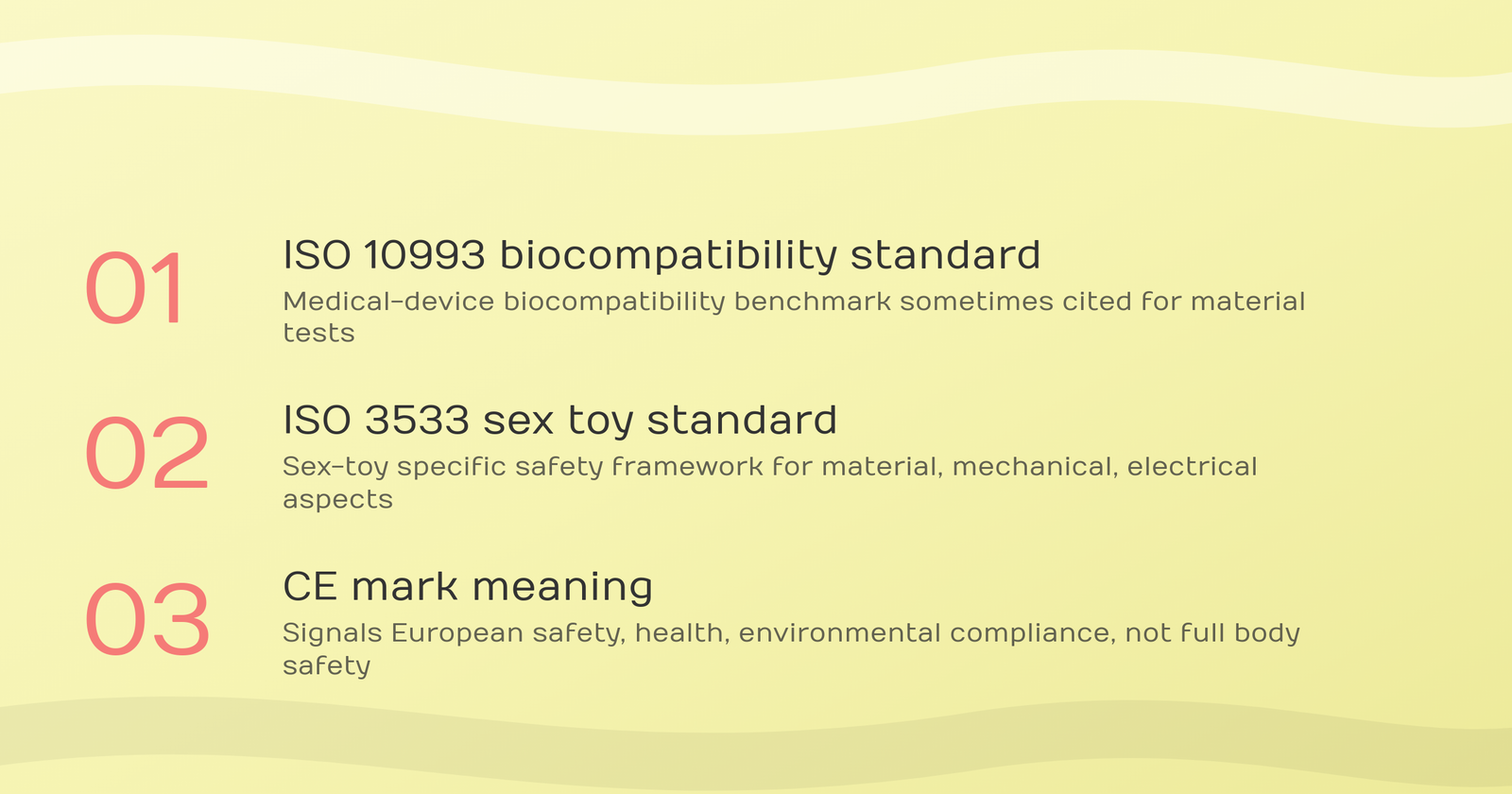
- ISO 10993. A biocompatibility testing standard used for medical devices. When a manufacturer references this standard and can provide documentation, it indicates the material has been evaluated for biological safety. It is rare to see it cited with actual test records, but worth asking for.
- ISO 3533. A safety standard developed specifically for sex toys, covering material, mechanical, and electrical requirements. Still not widely adopted, but its presence suggests a manufacturer is engaging with formal safety frameworks.
- CE mark. Indicates the product meets European safety, health, and environmental requirements. For electrical toys, this has real meaning. For material safety specifically, it is not a guarantee of body-safe composition.
- RoHS compliance. Restricts certain hazardous substances in electrical and electronic equipment. Relevant for vibrators with electronics; does not address all material safety concerns for non-electrical components.
The “For Novelty Use Only” Disclaimer
If you see “for novelty use only” anywhere on the packaging or product listing, treat it as a direct signal: the manufacturer is explicitly declining responsibility for the toy’s safety in body contact. This disclaimer exists because sex toys are not regulated as medical devices in the US, and some manufacturers use it to avoid liability for materials that would not pass safety scrutiny. It is one of the clearest red flags on a label.
Quick Checks You Can Do at Home
- Smell test. A strong chemical or plasticky odor when you open the packaging suggests off-gassing from plasticizers or other additives. A faint smell that fades quickly is less concerning; a persistent sharp smell is not.
- Surface feel. Tackiness or stickiness on the surface of a toy that was not there when new is a sign of plasticizer migration, meaning the material is breaking down and leaching compounds onto the surface.
- Price as a signal. Price is not a reliable indicator of material safety. Expensive toys can use poor materials with premium branding, and some affordable toys are made from genuinely body-safe ABS or silicone. Price tells you about positioning, not composition.
If you want to verify material claims before buying, luxury-tier products are more likely to include full material disclosure and reference third-party testing, which makes comparison easier. For anyone new to reading labels, a curated beginner category with vetted materials can simplify the process considerably. And once you know what a toy is actually made of, lubricant compatibility follows from there.
Which Material Works Best for Each Toy Type and Use Case
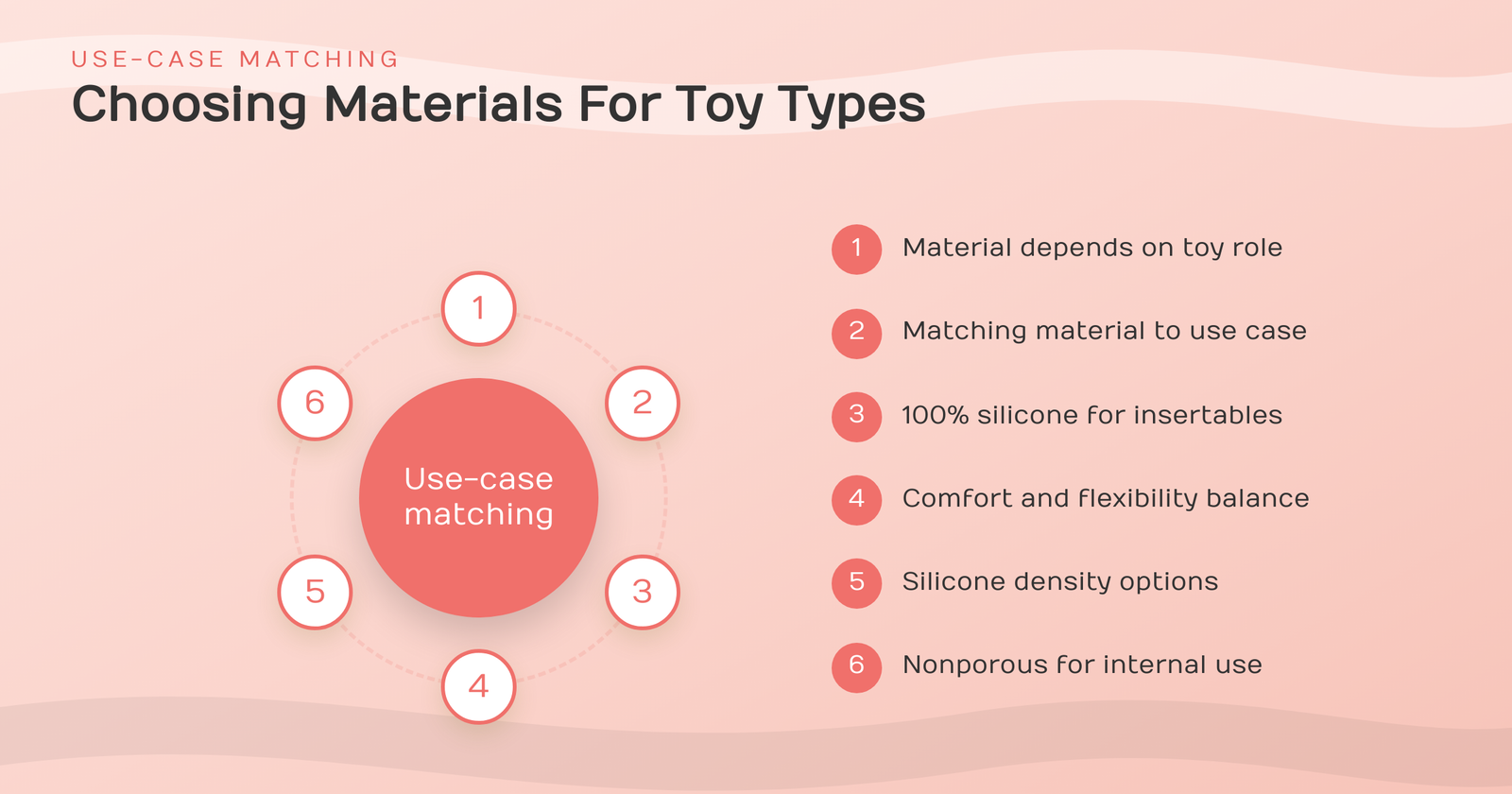
The right material depends on what the toy does, where it goes, and what matters most to your body. Here is how to match material to use case.
Dildos, Anal Toys, and Insertables
For dildos and other insertables, 100% silicone is the most versatile starting point. It is soft enough to be comfortable for beginners, flexible enough to accommodate natural body movement, and firm enough to provide meaningful sensation. Silicone comes in a range of densities, from very squishy to almost rigid, so you can choose based on how much give you prefer. It is also nonporous, which matters for anything used internally.
Borosilicate glass and stainless steel sit at the other end of the firmness spectrum. Both are completely rigid, which some people find more satisfying for G-spot or P-spot stimulation because there is no flex to absorb pressure. They are also heavier than silicone toys of comparable size, which adds a sense of substance. If you are new to insertables, that weight and firmness can feel like a lot at first, so it is worth factoring that into your choice.
Temperature play is where glass and stainless steel genuinely shine. Both materials conduct heat and cold readily. You can warm a glass dildo in a bowl of warm water or cool it in the refrigerator for a few minutes, and it will hold that temperature long enough to notice. Silicone does not conduct temperature the same way; it tends toward body temperature quickly and stays there.
For beginners, softer silicone is usually the best first insertable. It is forgiving, easy to control, and gentle on tissue. Once you know what firmness and shape you prefer, branching into glass or steel makes more sense.
Anal toys, including butt plugs and anal beads, have a short list of non-negotiable material requirements. The surface must be smooth and nonporous. Any texture that can trap bacteria is a problem for anal use, where the risk of irritation and infection is higher than with other insertables. Glass and stainless steel are particularly well-suited here: both are completely smooth, nonporous, and easy to clean thoroughly. A high-quality silicone plug is also a solid choice. Whatever the material, the toy needs a proper flared base.
Porous materials like TPE or jelly rubber are a poor fit for anal toys. As noted in the porosity section, these materials can harbor bacteria that cleaning does not fully remove, which is a meaningful concern for internal anal use.
| Material | Firmness | Temperature Play | Best For |
|---|---|---|---|
| 100% Silicone | Soft to firm (varies) | Minimal | Beginners, everyday use, flexible shapes |
| Borosilicate Glass | Rigid | Excellent | Firm stimulation, temperature play, anal use |
| Stainless Steel (316L) | Rigid, weighted | Excellent | Firm stimulation, temperature play, weighted Kegel trainers |
| TPE / TPR | Soft, flexible | Minimal | Not recommended for internal or anal use without a condom |
If you use weighted Kegel trainers, stainless steel is a natural fit. The density gives you meaningful resistance without requiring a large size, and the nonporous surface is easy to clean after pelvic floor sessions.
People with a history of UTIs or bacterial vaginosis, or those with chemical sensitivities, should lean toward 100% silicone, glass, or stainless steel for any insertable. These materials do not off-gas, do not absorb fluids, and are least likely to introduce irritants. If you have a latex sensitivity, confirm that any toy described as a “rubber blend” or “latex-free rubber” is genuinely free of latex proteins; silicone, glass, and steel sidestep the question entirely.
Vibrators, Strokers, and External-Use Toys
Most vibrators use ABS hard plastic as the primary shell material. ABS is nonporous, holds up well over time, and does not interfere with motor function. It transmits vibration efficiently, which is part of why hard plastic wands can feel so powerful: there is nothing soft to absorb the buzz before it reaches you. The trade-off is that ABS has no give, which some people find uncomfortable against skin during extended use.
Many vibrators address this with a silicone outer layer over an ABS core. The silicone softens the surface contact and makes the toy more comfortable to hold against the body, while the ABS housing still protects the motor. This combination is common in external stimulators, clitoral toys, and rabbit-style designs. Both materials are nonporous, so the combination does not create a hygiene problem.
Motor housing is a real constraint on material choice. Vibrators cannot be fully submerged in boiling water or run through a dishwasher the way a non-motorized glass dildo can. Check the manufacturer’s cleaning guidance; the cleaning method for your toy depends on its specific materials and whether it is waterproof.
Masturbation sleeves and strokers occupy a different category. The realistic texture and stretch that make these toys feel the way they do comes almost entirely from TPE, TPR, and similar porous real-feel blends. There is no nonporous material that currently replicates that softness and flexibility at the same price point. That means hygiene requires a deliberate approach: use a condom over the toy, or commit to thorough cleaning after every use and replace the toy regularly. The porosity section covers why cleaning alone has limits with these materials. If you use strokers or sleeves regularly, factor replacement into the cost of ownership.
For external vibrators used only on the vulva or outer body, the stakes around porosity are lower than for insertables, but nonporous materials are still easier to keep clean and less likely to degrade with regular use.
Lubricant compatibility varies by material; water-based lube works with every material type, while silicone-based lube requires more care depending on the toy’s surface. The lubricant section covers this in full.
Lubricant Compatibility by Material
Water-based lubricant is the one type that works safely with every toy material: silicone, glass, stainless steel, ABS plastic, TPE, TPR, jelly rubber, and latex. If you are ever unsure which lube to reach for, water-based is the correct default. It is also the only type safe to use when a latex condom is on the toy, since oil-based lubricants degrade latex and increase the risk of breakage.
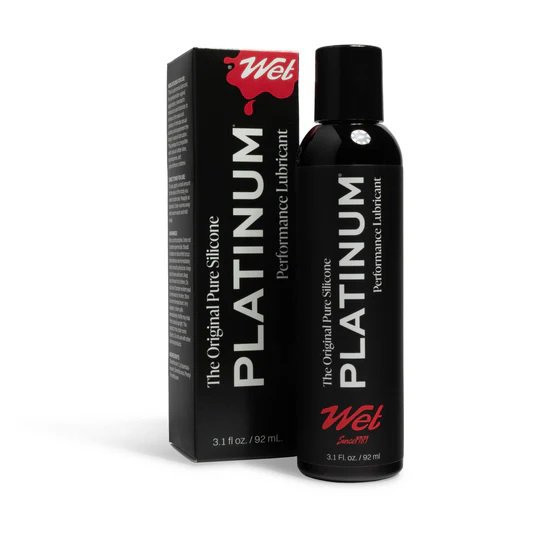
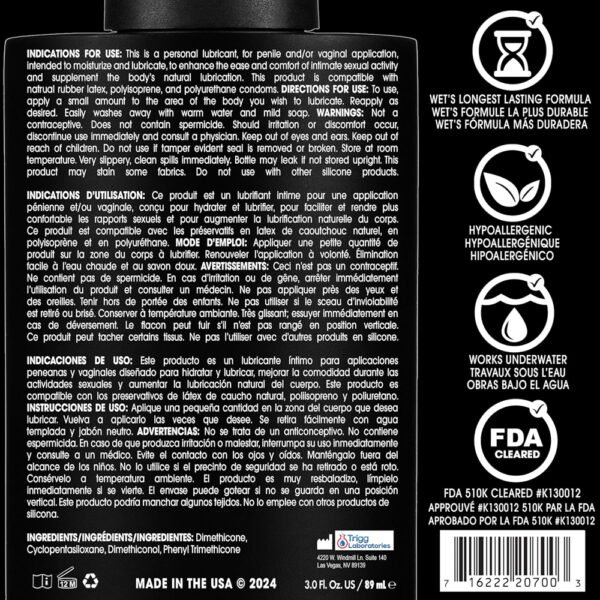
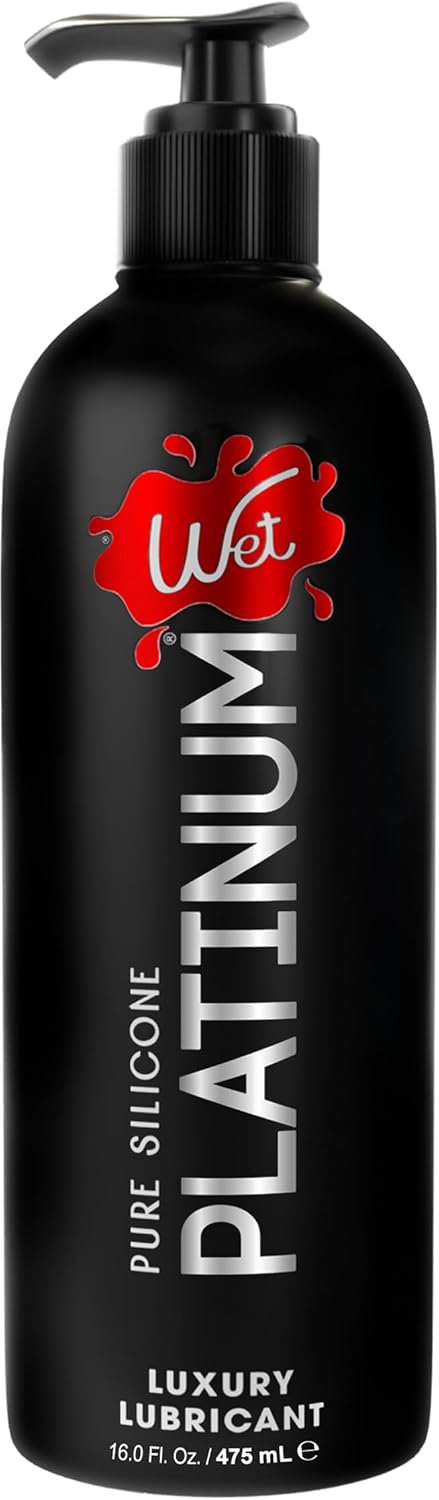
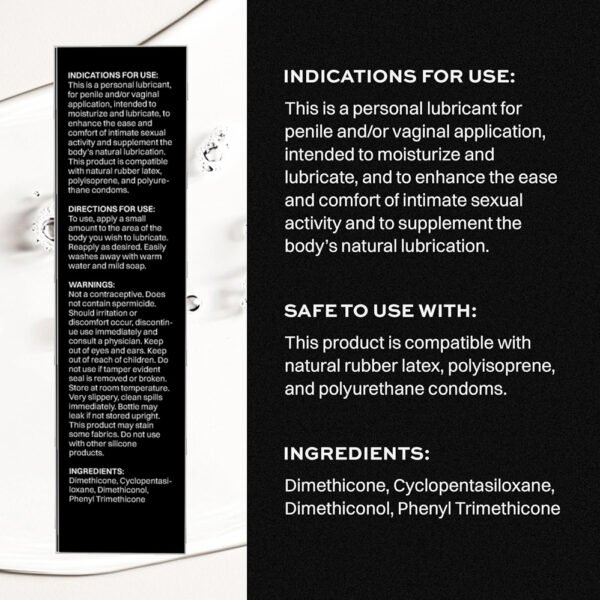
The more complicated question is when you can use something other than water-based, and why it sometimes matters. Silicone-based lubricant lasts longer, does not dry out mid-session, and is a popular choice for anal play in particular. But it has one significant limitation: it can degrade the surface of silicone toys. The interaction is chemical; silicone lube and silicone toy material can bond at a molecular level, softening or pitting the surface over time. The result is a toy that feels tacky, looks dull, or develops small surface breaks that are harder to clean.
Not every silicone toy reacts the same way. Higher-quality platinum-cure silicone tends to be more stable, while lower-density or blended silicone is more vulnerable. Before committing to silicone-based lubricant with any silicone toy, do a patch test: apply a small amount to an inconspicuous area, wait a few minutes, and check for tackiness or surface change. If the surface feels altered, stick with water-based.
The table below summarizes compatibility across the most common toy materials. (If you are unsure what your toy is actually made of, check the labels section before choosing a lube.)
| Material | Water-Based | Silicone-Based | Oil-Based |
|---|---|---|---|
| 100% silicone | Safe | Patch test first | Safe (no latex condom) |
| Borosilicate glass | Safe | Safe | Safe (no latex condom) |
| Stainless steel | Safe | Safe | Safe (no latex condom) |
| ABS hard plastic | Safe | Safe | Safe (no latex condom) |
| TPE / TPR | Safe | Not recommended | Not recommended |
| Jelly rubber / PVC | Safe | Not recommended | Not recommended |
| Latex | Safe | Avoid | Avoid |
Lubricant choice matters more for internal use than external. Internally, lube contacts mucous membranes directly, and any surface degradation on a porous toy compounds the hygiene concerns those materials already carry. For external-use toys like wand vibrators or air-pulse stimulators, the stakes are lower, but water-based remains the easiest, lowest-risk option.
One more condom-specific note: if you are using a polyurethane condom over a toy rather than latex, oil-based and silicone-based lubricants are generally compatible. Silicone-based lubricants can degrade silicone toys and oil-based lubricants can damage latex, but polyurethane does not share latex’s vulnerability to oil. When in doubt, water-based works with every barrier type and every toy material without exception.
How to Clean, Store, and Know When to Replace Your Toys
Cleaning Methods by Material
The right cleaning method depends almost entirely on what a toy is made of. Warm water and a mild, fragrance-free soap is the baseline for every nonporous toy, including silicone, glass, stainless steel, and ABS hard plastic. It removes surface residue, body fluids, and lubricant residue effectively when you rinse thoroughly and dry completely. A dedicated sex toy cleaner works well here too, especially for motorized toys where you want something formulated to be gentle on both the material and any seams or charging ports.
Beyond soap and water, your options expand depending on the material:
- Non-motorized silicone, glass, and stainless steel. These can be boiled for about three minutes, run through the dishwasher on the top rack without soap, or wiped with a sanitizer designed for body-safe toys. Boiling reduces microbial load significantly, but it does not sterilize in the clinical sense: it kills most bacteria and some pathogens, but not all bacterial spores. For home use, that level of cleaning is generally sufficient between solo uses.
- Motorized silicone toys. Skip boiling entirely. Warm water and soap, or a toy-safe cleaner applied to the surface, is the right approach. Keep water away from charging ports and seams. Non-motorized silicone can be boiled; motorized versions should be washed with warm water and soap and dried carefully.
- Glass and stainless steel. An isopropyl alcohol wipe is appropriate for these two materials only. Let the surface dry fully before use. Do not use alcohol on silicone, ABS, or any elastomer; it can degrade the surface over time.
- ABS hard plastic. Soap and warm water only. ABS is nonporous and easy to clean, but it is not heat-stable, so skip boiling and alcohol.
- TPE, TPR, jelly rubber, and similar porous elastomers. Gentle washing with soap and water removes surface-level contamination, but it cannot fully disinfect these materials. Their porous structure traps bacteria below the surface, where cleaning cannot reach. Using a condom over a porous toy during use limits direct contact and reduces risk, but it does not make the toy itself clean or safe for shared use. Washing and condom use together are a practical workaround, not a solution.
Whatever the material, dry your toy completely before putting it away. Moisture left inside a storage pouch or on a toy’s surface creates conditions where bacteria can grow. Pat with a clean cloth and let it air-dry for a few minutes before storing.
Storage, Inspection, and Replacement
Store each toy in its own breathable pouch or case, kept separately from other toys. This matters more than most people expect. When toys touch each other in a drawer or shared bag, materials can transfer chemicals to one another, soften, stain, or degrade at the contact points. This is especially pronounced with porous elastomers, which are chemically less stable and more reactive to neighboring materials. Many toys come with a storage bag; if yours did not, simple drawstring cotton pouches or the storage options made specifically for toys both work well.
Avoid airtight containers. A little airflow helps prevent moisture buildup. Keep toys away from direct sunlight, heat sources, and extreme temperature swings, which can accelerate material breakdown in silicone and elastomers alike.
How long a toy lasts depends heavily on what it is made of:
| Material | Typical Lifespan | Key Replacement Triggers |
|---|---|---|
| 100% silicone | Many years with proper care | Stickiness, surface breakdown, persistent odor |
| Borosilicate glass | Indefinite if undamaged | Any chip, crack, or surface irregularity |
| Stainless steel (316L) | Indefinite if undamaged | Deep scratches, pitting, loose components |
| ABS hard plastic | Several years | Cracks, surface crazing, motor or coating changes |
| TPE / TPR / jelly rubber | 6 to 12 months, often less | Stickiness, odor, discoloration, surface crumbling |
Porous elastomers degrade faster than any other common toy material. If a TPE or jelly rubber toy has become tacky, developed an odor that was not there at purchase, changed color, or shows any surface crumbling or flaking, retire it. These are signs of material breakdown, not just cosmetic wear.
For glass and ceramic toys, build a quick inspection into your routine before each use, and always after a drop. Hold the toy up to a light source and run your fingers slowly over the entire surface. Look and feel for chips, cracks, cloudiness along a line, or any rough patch that was not there before. Even a hairline crack is enough reason to stop using a glass toy permanently. A compromised surface can cause injury, and there is no safe way to repair it. When in doubt, replace it. Glass and steel toys that remain intact can last a lifetime; the only variable is whether they stay undamaged.
For any material, a persistent smell that does not wash out, visible surface changes, or a texture that has shifted from what it was when new are all reasons to replace a toy regardless of how long you have had it. Longevity is about condition, not calendar time.
How to Evaluate a Toy You Already Own
Start with the packaging and the brand. Look for the original box, hang tag, or any enclosed paperwork that lists the material. If you still have it, a full material disclosure, something like “100% platinum-cure silicone” or “borosilicate glass,” is a good sign. A vague label that says “skin-safe” or “premium material” tells you almost nothing useful.
If the packaging is gone, check the manufacturer’s website and search for the exact product name or model number. Many reputable brands list full materials in their product specs. If you cannot find it there, contact the brand directly and ask: “What is this toy made of? Is it 100% silicone, or a blend?” A company that makes body-safe products will answer that question clearly.
While you are looking, give the toy a physical check. These are the warning signs that matter:
- Strong chemical smell. A sharp, plastic, or sweet chemical odor on arrival, or one that develops after use, points to off-gassing from plasticizers. This is common in jelly rubber, PVC, and TPE blends, and it is a meaningful red flag.
- Tackiness or surface stickiness. A surface that feels sticky or grabby, especially on a toy that was not that way when new, indicates plasticizer migration. The material is breaking down.
- Discoloration, staining, or pitting. Spots, cloudiness, or small surface craters suggest the material is degrading and absorbing what it contacts. Neither cleaning nor storage will reverse this.
If you cannot identify the material at all, treat the toy as porous. Using a condom over it is a reasonable interim step, but it is not a long-term fix for a toy you use regularly or internally. At that point, replacing it with a verified body-safe alternative is the more straightforward call. A curated list of beginner-friendly options can help you find something with full material disclosure.
If a toy has caused itching, redness, swelling, or unusual discharge, stop using it immediately and see a healthcare provider. Reactions fall into two general categories. A latex allergy typically produces hives, swelling, or respiratory symptoms, and is triggered by latex or rubber-blend toys. A chemical sensitivity reaction, more common with jelly rubber or PVC, usually presents as localized irritation, burning, or contact dermatitis at the point of contact. Identifying the toy’s material helps your provider understand what you were exposed to.
Some toys should be retired right away, regardless of cost or sentiment: anything with a strong chemical smell, visible surface degradation, cracks, chips, or a reaction history. For any toy you decide to keep while you evaluate it, using an appropriate cleaner matters, though the right method depends on the material.
FAQ
Can thorough cleaning make a TPE or jelly rubber toy safe for ongoing use?
Can thorough cleaning make a TPE or jelly rubber toy safe for ongoing use?
No. Thorough cleaning significantly reduces surface bacteria, but it cannot fully disinfect a porous material. TPE and jelly rubber have microscopic channels that trap fluids and microorganisms below the surface, where soap, water, and toy cleaners cannot reliably reach. For occasional solo external use, the risk is lower and a condom over the toy adds a practical barrier. For internal use, shared use, or use after any infection, a nonporous material is the safer choice.
Does material affect how strongly a vibrator transmits sensation?
Does material affect how strongly a vibrator transmits sensation?
Yes, noticeably. Denser, harder materials like ABS plastic and aluminum conduct vibration efficiently, which means the sensation at the surface tends to feel stronger and more focused. Softer materials like silicone absorb some of the motor’s energy, which can make vibration feel more diffuse and rumbly rather than sharp. Wall thickness matters too: a thicker silicone body dampens more vibration than a thin one. If discreet, quieter use is a priority, softer and thicker materials also tend to muffle motor noise more than hard-shell toys do.
What should I do if I think a toy caused an allergic reaction or infection?
What should I do if I think a toy caused an allergic reaction or infection?
Stop using the toy and see a healthcare provider, especially if symptoms include unusual discharge, persistent itching, swelling, or discomfort that does not resolve within a day or two. Set the toy aside in a sealed bag so you can describe the material and any relevant details at your appointment. If you are unsure what the toy is made of, check the packaging or the manufacturer’s website before your visit, since knowing the material can help narrow down whether the issue is chemical sensitivity, a latex response, or something unrelated to the toy itself.